The visit to this Dambulla Royal
Cave Temple, also known as the Golden Temple at Dambulla in Sri Lanka, was part of
Sri Lanka’s ( Ezha Nadu ) Paadal Petra Sthalangal visit scheduled between 28th
November and 2nd December
2013. Utilizing this opportunity, we visited some Shiva, Murugan, and Amman
Temples, and epic Ramayana-associated sites of Sri Lanka.
The Dambulla Royal Cave Temple, or
Golden Temple, is one of the World Heritage sites (1991) of Sri Lanka. As per the historians,
this cave temple consists of natural caves, which were used by human beings during the prehistoric period, before the arrival of Buddhism in Sri Lanka. Prehistoric burial sites with human skeletons were found at Ibbankatuwa near
Dambulla.

ARCHITECTURE
This cave temple complex consists of
more than 80 rock caves, of which 5 caves are considered important. These 5
caves have 153 Buddha statues in various postures, Sri Lankan Kings, Gods, and Goddesses which include Ganesha and Maha Vishnu. Mural Paintings depict the story of
Gautama Buddha and the culture of Sri Lanka. The Mural paintings cover an
area of 2100 square meters.

There are two entrances to climb to the
top of the hill, and tickets are sold only at the south side entrance; the
other entrance is through the Golden Temple. The Caves are about 150 - 160 meters
high mountains and 364 steps with landing spaces are neatly cut into the rock/boulder to climb to the top of the Hill. The steps are covered at certain points
to take a rest in the shade.
The caves' hanging portions are
carved with grooves so that the rainwater will not enter the caves. The
ceilings of the caves are painted with intricate patterns, the Life story of
Buddha,
In 1938, arched Colonnades and gabled entrances were constructed. The 5 caves are separated by later brick walls with a single entry. The largest cave measures 52 meter on
east – west direction and 23 meters from the entrance to the back side of the cave. The highest point of the ceiling
measures 7 meters. There are about 153 Buddha statues, 3 statues of Kings, and 4
Statues of Hindu Gods and goddesses, including Ganesha and Maha Vishnu, in the
Dambulla Cave Viharaya.


The Golden Temple of Dambulla was
constructed at the base of the hill. This temple was constructed with sweeping
Chinese roofs. This part of the temple is the 2nd entrance to the
main Dambulla caves atop the rock.
The First Cave, also called Devaraja Lena...
A 15-meter-long Buddha in a reclining
posture is scooped out of the mother rock. Maha Vishnu is at his head in a sitting
posture, and Ananda, one of his disciples, is at his feet. Paintings of his
disciples in Anjali hastam / folded hands are on the back wall of the cave. The
Brahmi inscription is at the entrance of
this cave.

The Second Cave, Maharaja Lena, or the cave of Great Kings…
This is the largest and most
significant of all the 80-odd caves. This cave mainly comprises paintings
in red and gold shades. Almost all the surfaces of this cave are covered with
paintings. One of the significant paintings is the demon Mara trying to disturb
Buddha’s dhyana.
There are 56 statues of Buddha, of
which 40 are in a sitting posture, and the rest are in a standing posture. Along
with Buddha statues, there are two statues of the Kings Nissankamalla of
Polonnaruwa and Vattagami Abhaya of Anuradhapura, who are responsible for converting this cave into a Buddha Vihara. King Nissankamalla of Polonnaruwa’s period
inscription is at the entrance of this cave.

There is a pool of water inside
this cave. The water that drips from the top of the rock is collected in this pool.
Even during summer and drought, the water in the pool didn’t dry up, and the
dripping of water also never stopped.
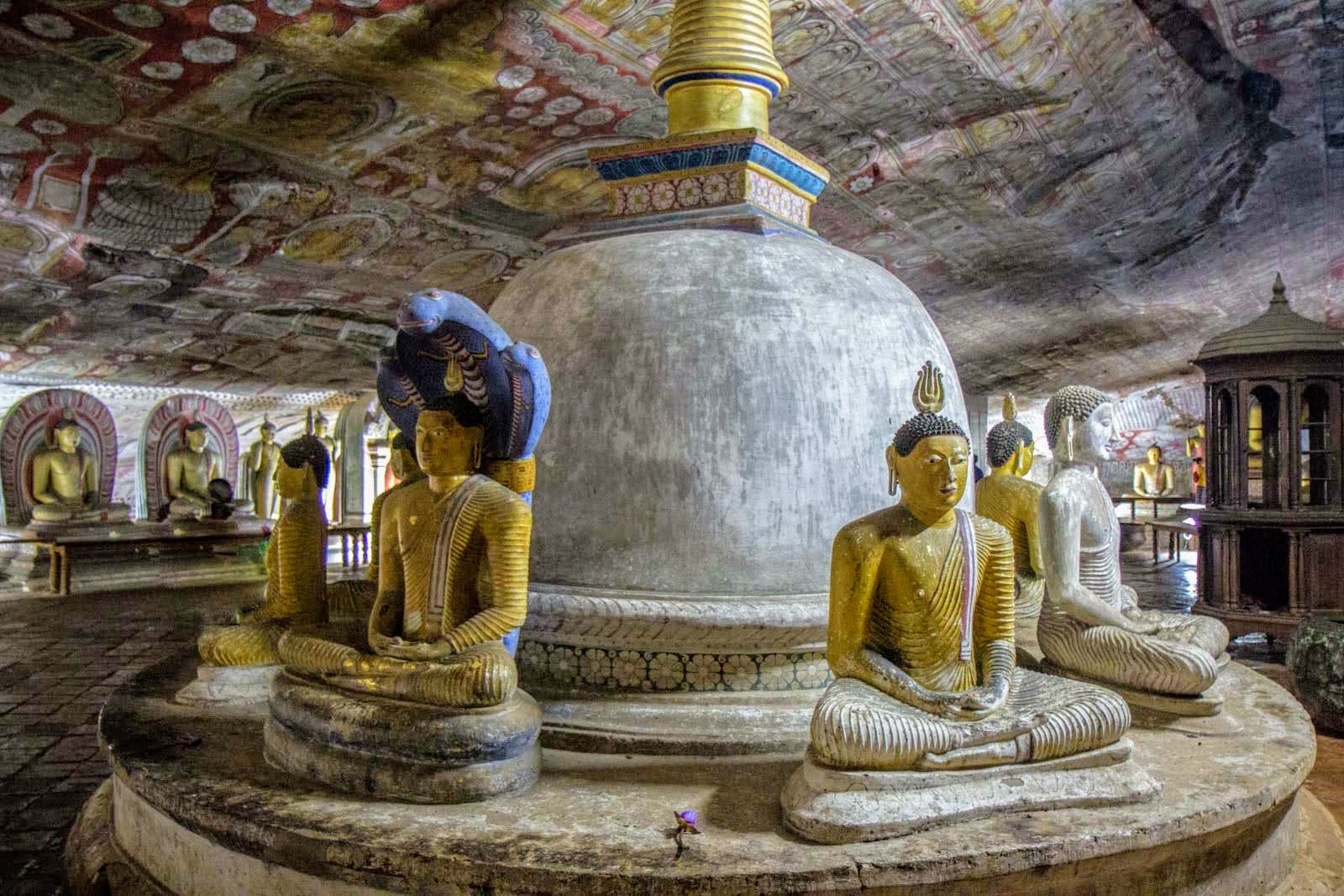
There is a small Dagoba inside this
cave. 11 Buddhas are around this Dagoba, which makes this cave a sacred
Viharaya. In addition to this, there are Hindu Statues of gods and goddesses.
Cave three – Maha Alut Viharaya....
Maha Alut Viharaya means the Great
New Monastery. The paintings in this
cave depict the Kandy style of art, which was practiced during the reign of
the beginning of the 18th century (1700s) King Kirti Sri Rajasimha.
Large numbers of Buddhas in reclining postures are in this cave. There are 50
more Buddhas, and the King Kirti Sri Rajasimha statues are also in the Cave. In
painting, most of them are Buddhas in
sitting posture, which cover the entire ceiling.

Cave Four – Paschima Viharaya....
This is one of the smaller caves
with Buddha statues in sitting posture and blue-colored rock paintings. There
is a small Dagoba with Buddha in a sitting posture. As per the local story, the Dagoba contains the jewelry of Queen Somawathi, wife of King
Valagamba, the initial founder of Dambulla Cave Temple. Hence, this Dagoba is called Soma Chaitya.
In addition to this, the Maha Vishnu statue is inside the cave.
Cave Five – The Devana Alut Viharaya.....
This cave was used as a storehouse
till the 19th century. Later, the same was converted into a mini shrine. There are Buddhas in reclining posture
and Sitting Postures in this cave. On one
Buddha, a snake hood is shown on top of the Buddha's head. These cave statues are not scooped out of mother rock; instead, they are
made of stucco, i.e., brick and plaster.

Golden Temple of Dambulla...
This is the latest addition to this
Complex at the foothills. A Small Dagoba is also near the Golden Temple. The
Golden Temple was constructed in Chinese style. The Golden Buddha is on the top
of the temple. The hands are in Dharmachakra mudra ... Gesture of Dharma. The
Museum also functions in this Golden Temple.

HISTORY AND INSCRIPTIONS
The Cave Monastery has been functioning to date as a major religious center for Buddhists since
established in the 1st to 2nd century BCE.
As per the Brahmi inscriptions, this
temple belongs to the 1st Century BCE. Valagamba of Anuradhapura, the
King of Anuradhapura (993 CE), is believed to have converted the cave into a monastery. He was exiled and lived for 15 years in refuge in this place. After
he captured Anuradhapura, the capital of his Kingdom, he converted this cave into
a monastery as a part of Thanksgiving for his prayer was fulfilled. The later kings added more to the caves, and by the 11th
Century CE, the Dambulla Caves Monastery had become a major and important
religious center, which continues to this day.
The 12th-century medieval
Sinhalese inscription after the arched entrance belongs to the period of King Nissanka Malla. The inscriptions record the various contributions made by the king to
the Dambulla temple. In 1190 CE, King Nissanka Malla of Polonnaruwa added about 70 Buddha statues.
Later in the 18th Century,
the caves were renovated, and some Buddha statues were painted with the Buddha’s life
story by the King of Kandy.
In 1938, the entrances of each
cave were constructed with triangular
gables along with arched colonnades.
At the base of the hill, the Golden
Temple was constructed in the 20th Century. A giant Golden Buddha
and a pagoda were added to the temple.
In
1960, protective coatings were applied to the mural paintings to avoid further
damage due to the change in the environment.
In
1982 – 1996, projects were carried out to improve the infrastructure
facilities and accessibility of the site in accordance with the UNESCO World Heritage Status. This involved the preservation of 18th-century mural paintings (retaining the 18th-century features) to avoid further damage from humans and environmental damage, renovation of floors with hand-cut paver
blocks, installation of modern lighting, and construction of museum and other
tourist facilities.

LEGENDS
The
Kings believed that all their problems, like victory in wars, getting relief from
the drought, etc., would be resolved after praying to the Buddha of this Dambulla Cave
Shrine. After the wishes were fulfilled, the Kings contributed to the development
of this cave shrine, the addition of Sculptures, gilding of the Buddha statues, and painting of the murals which depict the life history of Buddha and Sri Lankan
Culture.
POOJAS AND CELEBRATIONS
Even though this is one of the UNESCO
heritage monuments, this is a living Cave Viharaya of Buddha to date since the 1st
Century BCE. All Buddhist-related celebrations are observed.
TEMPLE TIMINGS
The visiting time is 07.00 hrs to
19.00 hrs, with an entry ticket of LKR Rs 1500.
HOW TO REACH
The Dambulla Cave is about 24 km from Habarana, 65 km from Anuradhapura, 71 km from Kandy, and 160 km from Colombo.
The nearest railway station is Habarana; from there, you can reach it by local bus or by cab.
By Car from Colombo... Colombo –
Negombo – Mirigama – Badagamuwa (via Central Expressway) – Galewela –
Dambulla
By Car from Kandy – Matale –
Palapathwela- Arangala- Lendola - Dambulla
LOCATION OF THE TEMPLE:
CLICK HERE


--- OM SHIVAYA NAMA ---
No comments:
Post a Comment