6th December 2013
Since I have completed the darshan of 274 Devaram
Paadal Petra Sthalangal, I would like to cover the balance of 2 Shiva temples in
Sri Lanka also. My ambition is to do the darshan of all the SRI LANKAN yathra.
28-11-2013, THURSDAY, FIRST DAY.
I was more anxious about the SRI LANKAN yatra
between 28-11-2013 and 02-12-2013, so I could not sleep well on the night of the 27th.
Reached Chennai Airport and joined Super Yathra Agencies of Kumbakonam to
catch the flight to Sri Lanka. (M/s Super Yathra Agencies, in
turn, has arranged this visit through Sri Lankan Holidays, a Travel Agency
in Sri Lanka and Chennai. Mr Denzil, our guide, explained Sri Lanka’s
History, Culture, Politics, Economy, Education, Religion, Business, etc.,
during the bus journey. The details are written at the end of this
article. It was a 5-day visit to Sri Lanka. After completing all the
formalities, we boarded the flight, which took off around
07.30 hrs from Chennai Airport. My long ambition came true when I
landed in Colombo, Sri Lanka, on an Air India Flight on the 28th.

Coming out of the airport in Colombo - Mr. Siddque of Super Yathra Agency leads the group
AIR INDIA flight takes off from Chennai - CLICK HERE
AIR INDIA flight takes off from Chennai - CLICK HERE
The train route to Mannar is under reconstruction after removing the
land mines laid by the LTTE. We could not see any people moving on the road.
On the roadside, shops were open, but nobody was there to buy. The name boards
were written in Sinhalese, Tamil, and English.
We were lucky enough to join the evening pooja after traveling a
distance of 215 km from Colombo Airport. There was not much of a crowd in the
temple. Regular poojas are conducted as per agamam. The Palavi River is
very near. Once it was a river, and now it is like a pond, and the water will be used
to do abhishekam to Mahalingam during Maha Shivaratri.
274 / 2. SRI THIRUKETHEESWARAM TEMPLE,( திருக்கேதீச்சரம் )
This is the 274th Paadal Petra Shiva Temple in Sri Lanka.

The 5-tier Raja Gopuram
Moolavar : Sri Thiruketheeswarar
Consort : Sri Gowriambal.
Some of the important features of this temple are …...
The temple faces east with a 5-tier Rajagopuram. Balipeedam, Rishabam, and Dwajasthambam are in front. At the entrance of the Rajagopuram, the Rishabam is an old one, and Ganapathi and Subramaniyar sannadhis. Adhikara Nandhi is on the left side of the Rajagopuram.
In the inner praharam are Suryan, Storage place, Yaga salai, Thirugnanasambandar, Kethu, Santhanasiriyars, Thirumaraikal, Chatur Vedas, Urchava murtis of Nalvar, Sekkizhar Peruman, 63var, and Sundarar. Next is Vinayagar, Somaskandar, Vishnu, Mahalingam (He was once a moolavar who was damaged during excavation), Subramaniyar, Deva Saba, Saraba Moorthy, Nataraja Peruman, Yaga salai, Bairavar, Saneeswaran, and Chandran.

Utsavars
Navagrahas are in a Nirutha mandapam. Ambal Sri Gowri Ambal is facing south. Malaysian Tamils, Yazhpanam Periyava Vasuvappa, Ponnili Udayar, Arulambalam, Mannar Asst. Govt. official Arumugam are responsible for the thirupani of this temple. The temple has 5 Chariots, of which the Moolavar’s is the biggest.
There are a lot of madams on the east street; some of them are Thirugnanasambandar madam, Sundarar madam, Nattukottai Chettiars madam, Amma madam, Pasumadam, Poonagariyar madam; on the south street Swamy madam, Sivarathri Madam, Nesavu madam, Sthapathis madam; on the west street Gurukula madam; and on North street Navalar madam, Vishwakarma madam, Thirukkuripu Thondar madam, Annadhana mandapam.
HISTORY
This temple is in the north part (North Province) of Sri Lanka at Maanthai
alias Maathotta Nagar on the banks of the Pallavi River ( Now it has become like a
lake) near Mannar. Once it was a port, used for business by the
Greeks, Romans, Arabs, etc. Maha Dhuvatta, a deva thachan, worshiped Lord
Shiva at this temple; hence this place was called Mahadhuvatta Puram and
later called Mathottam. Also, Manthai originally came from Maha
Sandhai (மகா சந்தை - a daily, weekly, monthly, or yearly held marketplace called sandhai)
The temple was completely destroyed by the Portuguese and was
reconstructed later. Next to this are the Pappa Mottai, Maaligai
Thidal, Vettaiyamurippu, Kovilkulam, Paddy field, Coconut trees, etc. During the Chozhas period, Chozha King Rajarajasekaran’s son Rajendran called
this place Arunmozhithevan Valanadu. Also called Manthottathu
Rajarajapuram. The Place Pappamottai once was a raised land occupied by the
Brahmins who had done pujas to this temple, and the
Vettaiyamurippu was used for conducting Thirukethareeswarar’s Vettai
thiruvizha.
The inscriptions from the old temple site tell us about the Chozha’s contribution to this temple. In addition to this, the inscriptions at Chidambaram
temple also throw some light on the thiruppani done by the
Pandya King Sundarapandian to this temple.
The temple was once under the control of Chingaiyaria Kings
who also controls the Rameswaram of Tamil Nadu.
Even though the temple was destroyed, the moorthams
were safely buried under the earth. This was informed by Sri la
Sri Arumuga Navalar, who lived in the year 1872, through bit notices, and he was instrumental in bringing out of the temple details to
this world after it was destroyed.
The temple was constructed on 43 acres of land through an open auction
for Rs 3100.00 by Thiru Rama. Aru. Palaniappa Chettiar from the British
Governor U Willams Duvanaima Durai in a postponed 2nd-time auction on
13-12-1893 (The first time went up to Rs 3050, which the Saivaites could not
mobilize the money and was asked by Christians).
The important people involved in the reconstruction of this temple are
Palaniappa Chettiar, Pasupathi Chettiar, and Neeraviyadi Vai. Arumugam, Vaithiyar
Ramu Pillai, Raghava Pillai from Tamil Nadu, and Latter for thirupani
Somasundaram Chettiar (1952) of Kulasekarapattinam,
During reconstruction, the old sanctum sanctorum,
Artha mandapam, Balipeedam, and Dwajastham were unearthed. Damage
occurred to the moola Lingam (Maha Lingam) during excavation was installed
in the praharam. The estimated cost of the temple was Rs 22000 for moolavar and
Ambal sannadhis.
Kumbhabhishekam was performed in 1903, 1910, 1948, 1956 (Sri Somasundaram Desikar, Madurai Aadheenam, and Polioli Sivapatha
Sundaram are responsible), 1960 (Sri la Sri Arumuga Navalar’s student Kasi vasi Senthilnatha Iyer with the help of
Tamil Nadu’s Sthapathis Tirupati), 1971 and 1976 in various
stages.
From 14-09-1956, the responsibility for the maintenance of this temple
was transferred to Eelam Sivanadiyar from Nattukottai Chettiars. But still, Chettiar participation is there.
The Somaskandar is the largest in the world and was made at
Ketheeswaram itself. The idol was made of panchalogam (5 metals), of which nearly
112 grams of gold had been added.

The biggest Somaskandar in the world (112 grams of gold was added while making)
For this temple, the Devara Thirupathigam meanings are written by Sri
Ponnambalam Pillai, the son-in-law of Sri la Sri Arumuga Navalar.
(The Details were taken from the temple's book released during the recent
Kumbhabhishekam, the Paadal Petra Sthalangal details book written by Thiru Pu. ma.
Jaya Senthilnathan of Kanchipuram Sankara Mutt and during the actual visit to this
temple).
LEGENDS
LEGENDS
The Lord was worshiped by Kethu, Maha Dhuvatta, Sri Ramar, Agasthiyar, and Ravanan. Since Kethu was worshiped, the temple was called Thiruketheeswaram.

Moolavar vimanam

Rishabam Mandapam

Maha
Lingam (This is the original one. This was damaged during excavation and
hence installed in the praharam)
We could not see many houses near the temple. Since we were running short
of time, we could not go around the temple and also had to travel to
Anuradhapura, where we had to stay at Hotel Mirinday for the next day’s travel to
Thirukonamalai.


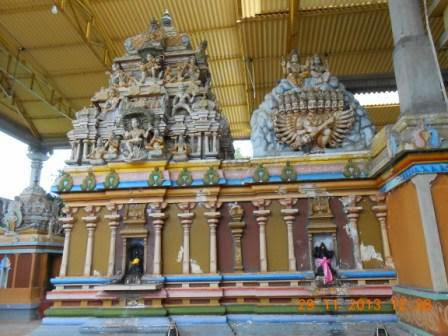
29-11-2013, FRIDAY, SECOND DAY.
The second day’s journey was a tough one, and the total distance covered
was 488 KM both up and down. The reconstruction of the road from Anuradhapura
to Trincomalee is in progress after removing the land mines laid by LTTE
during the war.
The temple is on a small hill near the seashore. The bus dropped us at
the base of the temple. A fort was built around the temple by the Portuguese
after destroying the temple. Most of the people preferred auto-rickshaws, and a few people
climbed up the hill along with me, enjoying the beauty of nature. We could
see a lot of military movement on the road. Reached the Temple around 11.45 hrs.


A Poster of the temple at the entrance
273/1. KONESWARAM TEMPLE, THIRUKONAMALAI
( Trincomalee- திருக்கோணேச்சரம் திருக் கோணேச்சரம் கோயில் )
This is the 273rd Paadal Petra Shiva temples in Sri Lanka.

Entrance to the temple with Rajagopuram on the north side
Moolavar : Sri Thirukoneswarar
Consort : Sri Mathumayal
Some of the important features of this temple are...
The temple faces east with a 3-tier Rajagopuram. Artha mandapam,
Snapana mandapam, Vasantha mandapam, Yagasalai, and
Pagasalai are in the temple as per Agamam. In Snapana mandapam, Sri
Sivakama Sundari Sametha Sri Natarajar.

View of moolavar from Dwajasthambam
In Deva Sabha, panchaloha moorthams of Sri Valli Deivanai
Sametha Sri Subramaniar, Somaskandar, and Chandrasekar are worth seeing. In the praharam, the murtis of Suryan, Chandran, Naagar,
Bhairavar, and Chandikeswarar are. Kasi. The present temple was
reconstructed as per Aagamam. The old idols of Sri Mathumayal
sametha Sri Koneswara, Chandrasekar, Parvathy,
Pillayar, and Asthira Devar, taken from the wells and ponds, were
reinstalled. (This was found out when the Govt.
authorities were excavating a well).

Moolavar Vimanam
HISTORY
This temple has a history of 3287 years. This place was originally
called Thirikooda. During that period, there were three temples: one on
the hilltop, one in the middle, and a third at the base of the
hill. The old temple was destroyed by the Portuguese after taking
the drawings of Vimanas and Rajagopuras. I was told that the drawings are
still available in the Visben (Lisbon ?) museum.
The idols were saved by the devotees and dropped
in the wells and ponds to be taken out in the latter period during the Portuguese war. New temple reconstruction was started after independence in 1950, and the Shiva Lingam was brought from. The temple has land for burning lamps with ghee, and the
Lotus thread was used.
This temple is situated in a beautiful atmosphere with
good water springs and near the Bay of Bengal.
Service institutions with residences are around the temple.

The Portuguese Fort

Entrance to the fort

The history of the fort

Banyan trees

Direction board to the temple

A banyan tree is swallowing the palm tree

Blackbuck deer are grazing

The guns may be used by the LTTE.

Stucco image of Lord Shiva

Ambal Sri Mathumayal Sannadhi

Natarajar Sabha

West side Rajagopuram

Utsava Idols

History of the temple

Stucco images around Kal alamaram/Banyan tree, grown on the rock)

Ravana worshiping Lord Shiva - A stucco image
As
planned, we could not see the Bhadrakali Amman Temple (Built during the 11th century
by the Tamil King Rajendra Chozha), so we proceeded to Anuradhapura. On
the way, we went to KANNIYA Hot Water Springs. It must be a place of volcanic activity. It was believed that these 7 hot water springs/wells were
created by Ravana for his mother's last rites. The water in the wells has different
temperatures. The first one has a high temperature, and the last one has a lower temperature.
Kanniya Hot Water Springs.


The Seven Hot Water Wells
Also, we saw a dilapidated structure partially excavated. It was said that the structure was built by two Kings who ruled that place. Since the structure is adjacent to the hot water wells, the structure might have been used to perform the last rites. We could not find any inscriptions.

The excavated dilapidated structure
Also, there is a Shiva Lingam housed in a building, constructed
recently. (The Shiva Lingam must be an old one and might have been taken from the
dilapidated structure). Reached Anuradhapura Hotel around 19.30 Hrs.

Shiva temple
30-11-2013, SATURDAY, THIRD DAY.
Continued
our third-day journey From ANURADHAPURA to KANDY.
Arulmigu Kathiresan Kovil / Kathiresan
Temple/ Kadireshan Kovil / அருள்மிகு
கதிரேசன் கோவில், Anuradhapura, Sri Lanka.
First, we went to a Murugan temple. There is no main idol; instead, a Spear / Vel is installed. In the praharam are Vinayagar, Murugan, Nagar, Lakshmi, Navagrahas, and Natarajar Sabha.

Front tiles roof mukha mandapam

Our group

Moolavar Vimanam

Sannadhis in the prakaram
Dambulla Royal Cave Temple and Golden Temple / Buddhist Temple, Dambulla, Sri Lanka.
On the way, we went to Dambulla, a Buddhist temple. This temple
was built during the First century and has
5 caves with paintings like Ellora and Ajanta in India. Due to a lack of time, we did not go inside.


Buddha Temple

On the way to Kandy, we visited the Ranweli
spice garden at Matale, where a lot of spices were grown. There were about 23
varieties of medicinal plants. It was believed that a piece of Sanjeevani hill
had fallen down, which Hanuman brought from the Himalayas to cure Lakshman (Rama). Guides explained the benefits of spices and medicinal plants. Massages
are done using the herbs (free and sample). We had our lunch at Matale Spice
Garden restaurant.

Jathi kai with Jathipathri.


Coco

Ladies are playing drums to entertain the tourists

Name Board
Sri Muthumari Amman Kovil / ஸ்ரீ முத்துமாரி அம்மன் கோவில் – மாத்தளை / Matale, Sri Lanka.
After Lunch at Matale Spice Garden
Restaurant, we went to Sri Muthumariamman Temple. This temple has a 9-tier
Rajagopuram with a magnificent view. Kumbhabhishekam was performed recently.
Most of the Stucco images were done by Tamil Nadu Mamallapuram
Sthapathis. The history of the temple goes like this. During British rule, Tamil
people from India were brought to Sri Lanka to work in the Tea Estates
with a heavy workload. People were accommodated in a cramped shelter. Due
to unhygienic conditions, people got measles. Then they worshiped
Muthumariamman and got cured. To thank for relieving from the disease they
constructed this temple and expanded later.

West side entrance

The 9-tier Rajagopuram

The 9-tier Rajagopuram


South side entrance

View of the temple complex
Sri Somasundareswarar Temple / Pillaiyar
Kovil, Kandy, Sri Lanka.
Moolavar : Sri Soma Sundareswarar
Consort : Sri Meenakshi
The important features of this temple are….
The Rajagopuram is of 5-tiers with a magnificent
view. Nandhi peruman in a silver kavasam, which is unique in this temple. Balipeedam, Dwajasthambam, and Rishabam are after the Rajagopuram. In the koshtam are Dakshinamurthy, Lingothbavar, Brahma, and Durgai.
In the inner praharam are Bhadrakali Amman, Naalvar, Kalyana Venkatesa
Perumal, Maha Ganapathy, Somasundarar, Rajarajeswari (Urchavar), Kasi
Viswanathar, Visalakshi, Pancha Lingam, Maha Lakshmi, Arumuga Swamy, Navagrahas (In sitting posture), and Thillai Chirsabai.
In the Mandapam sannidhi for Dhandayuthapani, Selva Vinayagar, Panchamuga
Vinayagar, Meenakshi Ambal, and Palliyarai.
The mandapam paintings belong to the Vinayagars. The temple and mandapam
are built of stone by Nattukottai Chettiars.

The 5-tier Rajagopuram

Pancha mukha Lingeswarar

Thillai Chitrambalam

Vinayagar - Urchavar

Nandhiyam Peruman after abhishekam
Sri Dalada Maligawa, A Buddhist Temple, Kandy, Sri Lanka.
After the darshan of Lord Sri Soma Sundareswarar, we
went to a Buddha Temple – Sri Dalada Maligawa, Kandy. The temple has the
relic of Buddha’s teeth. The relic was kept at the center of the building
on the first floor, which is made of wood with intricate carvings. There are a lot of
paintings and Murals. One such painting was about the function of bringing rain.
People with a whip/chavukku, fire lamps, Sri Lankan nadhaswaram, and drums, and elephants with relics go in procession. This signifies the Thunder, Lightning, wind, and rain clouds (Elephants). The river Manavali flows around the city of Kandy. The meaning of Kandy is Sanyasi City. (Kandy – Senkatapura, Senkata =
Sanyasi, Pura = City). After visiting Buddha’s relic–teeth temple stayed at
Hotel Senani, Kandy. It was interesting to note that Buddha had visited Sri Lanka three times.

Entrance to the Buddha's temple (Security check will be done here)

View during the night - a beautiful lighting view

Sinhala music is being played before opening the shrine


The Architecture of the central mandapam where Buddha's relic is kept - see the beauty of the mandapam kodungaikal

The painting of Buddha's relic was carried hidden in hair by the princes Hemamali and her husband, Prince Dantha.

A painting of Buddha's relic was carried hidden in hair by the princes Hemamali and her husband, Prince Dantha.

Some of the paintings

Some of the paintings

Some of the paintings

Painting of the temple, 1891 CE
We stayed at Hotel Senani. The garden at the hotel was
maintained beautifully.


Thiruvodu tree
01-12-2013,
SUNDAY, FOURTH DAY
From KANDY we proceeded to KATARAGAMA (Kathirkamam). On the way, we crossed the City of NUWARA ELIYA. This means the City
of Lights. Tea and rubber plantations are important activities in this
place. This place is also called Little England, where British people
stayed here during summer.
On the way, we saw the waterfalls
called Ravana Koda (Thawalanthenna). It was believed that Ravana had
taken a bath in these waterfalls.

Ravana falls
Then
we went to the Hanuman Temple on a small hill. The temple is about 2.5 km off the main road. Due to a lack of time, we were advised to go by AUTO to the Hanuman temple.
The temple is being maintained by the Chinmaya Mission. The Hanuman statue might be about
20 feet tall. It is believed that Hanuman visited this place first in search
of Seetha. Special poojas are conducted every full moon day. At the base of
this hill, there is a small Vinayagar sannidhi called Sri Varadharaja
Vinayagar.
 |
Sri Varadharaja
Pillayar - at the base of the foothill
|

Hanuman Temple

Hanuman Painting on the basement floor

A beautiful mountain view
After Hanuman’s Darshan, we went to GAYATHRI
PEEDAM at NUWARA ELIYA. Also called Gayathri Siddhar Peedam. There are 108 Bana Lingas brought from the Narmada River of India, waiting for installation.
It was believed that the Lingams are growing day by day due to regular poojas, and sweating also appears on the banam. The Peedam was founded by Sri Sri
Murugesu Swamigal and managed by his disciple Sri Kannaya Swamikal.
It was believed that Ravana’s son Meganathan (Indrajith) had done dhabas at this place to get victory for his father. To
acknowledge his dhabas, Mummoorthigal came to this place and blessed him. (Despite this, Ravanan was defeated by Sri Rama is the real story).
SRI GAYATHRI PEEDAM at NUWARA ELIYA.
Moolavar : Sri Mrityunjaya Devan
Consort : Sri Gayathri Devi (
with five faces in a sitting posture )
In the mandapam, idols /sila roopam of Mummoorthigal (Shiva, Brahma and Vishnu) along with Sri Vinayagar. In Gayathri Devi’s
sannadhi koshtam, Sri Rama Gayatri, Vishnu Gayatri and Krishna Gayatri.
There are separate sannadhis for Sri Agasthiyar and Vishwamitra.

Entrance to the main shrine


Shiva, Brahma, and Vishnu

Agasthiyar

Vishnu Gayatri
After
lunch, we went to SEETHA ELIYA – Seetha Amman Temple. In the main sannadhi
both marble and stone moorthams of Anjaneya, Lakshmanan, Ramar, and
Seetha. There is a separate sannadhi for Anjaneyar. The guide showed us the
footprint of Anjaneyar on the riverbed. In the mandapam, there are painting of Ramayan Story.
SRI
SEETHA AMMAN TEMPLE

Entrance from the side - Road at a higher level

Moolavar Vimanams

Moolavar Vimanam


Lakshman, Ram, and Seetha (Marble and Stone moorthangal)

Hanuman Sannidhi

Paintings of the epic Ramayana story

Paintings of the epic Ramayana Story

Hanuman's footprints.

Ashoka Vanam, where Sita was kept
Our
previous plan was to have the darshan of Kathirkamam Murugan on the fifth day.
Since we had to travel a long distance on the fifth day, we decided to
have the darshan on the fourth day itself. So we straightaway went to
KATARAGAMA (KATHIRKAMAM) Periya Kovil. A Buddha sannadhi was also constructed
to the left of Sri Vinayagar Sannadhi. The details are as follows.
Ruhunu Maha Kataragama Devalaya (Kathirkamam) Periya Kovil, Kataragama, Sri Lanka.
In the
main shrine sannadhi for Buddha, Vinayagar, and Sri Murugan.
On the
right side, separate sannadhis for Vishnu Koil, Bhairavar, Deivanai, and Guru peedam, where we can see the 7 Siddhar jeeva Samadhis.
Valli
Sannadhi, Bhadrakali Amman, and Sivan sannidhi are opposite to the main shrine.
It was
believed that there were no idols/murtis inside the sannadhi, and we had to worship
the screens printed with the respective gods. (Some people said that there is a
chakram and soolam inside, and poojas are conducted for that.)
In the
Murugan temple large-sized pictures of Sri Valli, and Deivanai with Murugan
marriage. Once a year, Lord Murugan will come out and marry Valli near Valli
Sannadhi. At that time also, the murti will not be visible. Will be completely covered
with flowers.
The night
pooja is being conducted by Muslims (Do not know the reason)
The
hunter people are given importance in this temple since Valli belongs to
Veduvar kulam (Hunters).
On the
entrance arch, neon light is written as KATARAGAMA PERIYA KOVIL (The direction
sign board also says that Ruhunu Maha Kataragama Devalaya).

Direction board

Entrance arch to the Kathikamam Murugan Temple


Sri Murugan Sannadhi

Buddha's sannadhi

A Big Peepal (Bodhi tree)

Must be a Shiva Lingam

Valli's sannadhi

Valli is standing under the tree

Shiva Temple

The man in blue is Mr Srinivasan of Samrat Travels, who had arranged for Kailash darshan
02-12-2013, MONDAY, FIFTH DAY.
Today
is the last day in Sri Lanka, and we have to travel a long distance to reach
Colombo. We traveled along the seashore. On the way, we spent some time
at Galle Beach. The tides were very high due to the new moon. We saw many
people surfing on the tides.


Galle beach
Video taken at Galle Beach to see: CLICK HERE
Video taken at Galle Beach to see: CLICK HERE
Also, we crossed the Galle Fort constructed by the Dutch (This is the place where the Thiruchendur Idols are Kept, which were stolen by the Dutch). And
opposite to that, there is a Cricket stadium

Fort built by the Dutch
From Galle to Colombo, we traveled through the Expressway at a speed of 100 km per hour. The road was very good, and we were able to
cover the distance of 110 km in an hour. The traffic was very minimal, and we
could not see any lorry movement. There were no road intersections throughout
the stretch. Sitting on the bus, we saw the Parliament, Parks, and the corporation building (Like the White House of the USA).

Convention hall

White House - Corporation Govt Building

A Park
From Galle to Colombo, we traveled on the Expressway at a speed of 100 km per hour. The road was very good, and we were able to
cover the distance of 110 km in an hour. The traffic was very minimal, and we
could not see any lorry movement. There were no road intersections throughout
the stretch. Sitting on the bus, we saw the Parliament, Parks, and the corporation building (Like the White House of the USA).

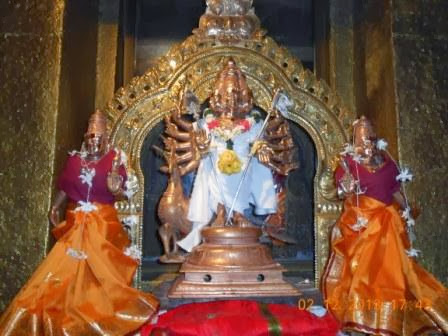
Before going shopping, we went to Sri Ponnambala Vaneswarar temple.
The temple was built about 150 years ago by Nattaukottai Nagarathars. Mr
Ramanathan is one of those involved in the construction of this temple.
Sri
Ponnambalawaneswarar Devastanam Kovil, Kotahena, ஸ்ரீ பொன்னம்பலவனேஸ்வரம் கோவில். கொட்டாஞ்சேனை ශ්රී
පොන්නම්බලවානේස්වරර් දේවස්ථානය,
කොටහේන, Colombo, Sri Lanka

The 5-tier Rajagopuram
Moolavar : Sri Swarna Sabeswarar Swamy
Consort : Sri Sivakami Ambal
Some of the important details of this temple are …..
The Rajagopuram is of 5 tiers. Balipeedam, Dwajasthambam, and Rishabam are
in the inner praharam. In the koshtam, Vinayagar, Dakshinamurthy, Lingothbavar,
Brahma, and Durgai.
In the praharam, Kanni Moola Vinayagar, Somaskandar, Pancha Lingangal, Maha
Vishnu, Valli Devasena Subramaniar, Urchavars,
Saneeswaran, Urchava Moorthangal, Bhairavar, Swarna Bhairavar, Navagrahas,
Chandran, Suryan, Yaga Salai, and Naalvar.
In the Maha Mandapam, Urchavar is kept inside screens printed like Shiva
and Parvati in Kailasam with motor operation.
Ambal Sri Sivakami is in a separate sannadhi facing south. The praharam lamps are similar to those at Thiruvannamalai temple. The outer praharam is spacious with sannadhi for Anjaneyar.
Muthumariamman and Naagar.
The temple was built of stone by Nattukottai Nagarathars

Urchavar - Sri Valli Devasena sametha Arumugar

Lingothbavar

Hanuman, Lakshman, Ram, and Seetha
Went
shopping after darshan. This is the last item of our visit to SRI LANKA. We
had spent our fifth day’s night at Hotel Global Towers. This hotel was
ceremonially opened in Aug 2004 by then-Prime Minister Mahinda Rajapaksa.
 Our guide, Mr Denzil



Early
morning around 05.30 Hrs reached Colombo Airport. Converted my Sri Lankan
currency to US Dollars ( may be useful for future travel ).
Goodbye
to Sri Lanka.
After
completing all the formalities the flight took off at 09.30 Hrs and
reached Chennai around 11.00 Hrs, After reaching Chennai scared of walking on
the roads by seeing the traffic and people everywhere.
ABOUT
SRI LANKA – MY OBSERVATIONS.
The Name
Lanka was obtained from the Great Ramayan Story and later Sri was
added. The preset Capital is Kandy after Anuradhapura. The Capital
will be decided based on the place where the Buddha relic is being kept. The main
language is Sinhala. ( It was interesting to note that the written
language was done by 18 Tamil Scholars who came from India). The name Sinhalese
came after a King, who ruled Sri Lanka and was born to a Bengali prince
and a Lion. Singa – Lion and Le – Blood, Blood of a Lion.
The
important kings who ruled were the Cholas and Pandyas from Tamil
Nadu, India. Later, the British, Portuguese, and Dutch.
The total
population of Sri Lanka is 2 crore, of which 80% are Sinhalese, and
18% are Tamilians. The major religion is Buddhism. The main
income of the Island is from Tea, Rubber, Spices, and precious stones like
Sapphire, Emerald, Topaz, Coconut, and lastly Tourism.
- The important jobs are Tea plantation, Agriculture (paddy cultivation is by direct sowing), and fishing.
- There are 5 main rivers. The climate is not too warm and not too cold. Sri Lanka gets rain from two monsoons via the southeast and Northwest. We can see green everywhere.
- The roofs of the houses are built with tiles or asbestos, except for multi-story buildings.
- Most people are energy conscious and use energy-efficient CFL bulbs, and even street lights are fitted with CFL lamps.
- Vehicles are imported from Japan and India. Most of the buses are from TATA, Ashok Leyland, and Isuzu. Four-wheelers are from TATA, Maruti, Toyota, Mahindra, etc. In three-wheeler Bajaj, TVS and Ape. Motorcycles are from Bajaj, Honda, Suzuki, and TVS.
- The cost of living is high since most of the materials are being imported.
- The Autos are painted Red, Green, Black, and Beige depending on the year of registration. The numbers are similar to those in our country, starting with their provenance. The Autos are not fitted with meters but are charging nominally.
- The roads are very good for travel and driving. Has minimum Signals.
- People are very disciplined and used to cross mainly at zebra crossings. The drivers stop their vehicles when people cross the road.
- The crime rate is very low, and the Sinhalese are cordial and friendly. The people are more afraid of religious laws than the Laws enforced by the Government.
- Education is Compulsory up to school and is free.
- The important thing we noticed was that there was no waste like Plastic, paper, etc. strewn on the streets. Streets and roads are kept neat and clean.
- Marriages are mainly arranged by the parents. It is conducted over two days. The first day will be at the bride's house and all the colors will be white (Dress and all the materials used), and mainly relatives of the bride will attend. The second day of the marriage will be at the bridegroom's residence, and the bridegroom's relatives will be attending. The color of the dress and materials will be red. The main qualification for the Bridegroom is that he should run a business or a Job and also possess his own House. Mostly, divorce and remarriage are avoided. The girl, after marriage, will be given importance in society if she gives birth to a child as early as possible.
- Last but not least, we could not see real estate or advertisements in any form throughout Sri Lanka.
The Tour
Operators may be contacted for further details
1. Super
Yathra Agency, Nageswaran Street, Kumbakonam.
Contact
person: Siddique
Contact
numbers: 9443875802, +914352400557
2. Sri Lankan
Holidays, No. 9 North Bog Road, T Nagar, Chennai 600017
Contact
Person: R C Shoba
Contact
Numbers: 9789846615, 43546651, 45544242,43546641
E-mail
address: lsrsrilanka@gmail.com
3. DENZIL
K D D Wijesinghe, No. 30 A 70, Rukmalgama, Pannipitiya, Sri Lanka.
Contact
Numbers: 0773519519, 0773948808, 0777615128
Email
address: denziltourism@gmail.com
 Our guide, Mr Denzil

The bus crew in front of a tea factory

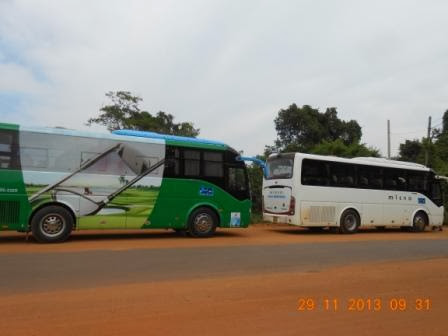
The Luxury coaches (cost 1 crore Sri Lankan Currency )

Roommates - Mr. Thangaiya ( a Retired Professor, 84 years young), Rajendran from Mayiladuthurai, and myself.

See the water droplets
---OM SHIVAYA NAMA:---
ReplyDeletelsrsrilanka
Dec 14 (3 days ago)
to me
Dear Mr. Veluswamy
Greetings from LSR – INDIA!!!
We are very much impressed with the details written in your blog and the way it is presented. We wish to say you have been a professional but your photography and the writing skills is more professional than a reputed writer.
I will be forwarding this to our head office to our chairman and the directors. Also I will request them to send this one to the Sri Lanka tourism board to be published as a guiding article and also looking at the possibility of publishing in a week end news paper in Sri lanka.
Thank you very much for sending and it is a great inspiration.
Kind regards
Benno Gnanapragasam
Country Manager - India
Lanka Sportreizen(LSR) Pvt.Ltd
Old no 3,New no #9,North Borg Road,T Nagar,Chennai 600 017
Tel 0091 (44) 43546651/0091 (44) 45544242/Fax 0091 (44) 43546641/(M) 0091 8754504031
E mail: Lsrsrilanka@gmail.com
Web Site: www.lsr-srilanka.com
www.facebook.com/LSRINDIA
Save our Planet. Please do not print this email unless you really need to
From: Velu Chamy [mailto:veluchamy.v.a2002@gmail.com]
Sent: Friday, December 13, 2013 5:04 PM
To: lsrsrilanka@gmail.com
Subject: Srilankan Tour between 28-11-2013 to 02-12-2013
__________ Information from ESET NOD32 Antivirus, version of virus signature database 9171 (20131213) __________
The message was checked by ESET NOD32 Antivirus.
http://www.eset.com