PLACE |
DESCRIPTION |
Adhi Thiruvarangam |
Sri Ranganatha Perumal Temple |
Elavanasur |
Ardhanatheeswarar Temple |
Elavanasur (Pidagam) |
Ardhanatheeswarar Temple |
Jambai |
Jyeshta Devi in Shiva Temple |
Jambai |
Lakuleesar |
Jambai |
Mahaishasuramardini |
Jambai |
Sri Jambunatheswarar Temple |
Jambai |
Sri Jambunatheswarar Temple |
Jambai |
Thavvai /Jyeshta Devi |
Koovagam |
Sri Koothandavar Temple |
Koovagam |
Sri Koothandavar Temple |
Neivanai |
Swarnakadeswarar Temple |
Parikal |
Lakshmi Narasimha Swamy Temple |
Rishivandiyam |
Sri Arthanareeswarar Temple |
Sithalingamadam |
Sri Viyakrapatheswarar Temple |
Sithalingamadam |
Sri Viyakrapatheswarar Temple |
Thimmachur |
Jyeshta Devi / Thavvai |
Thimmachur |
Sri Kailasanathar Temple |
Thirukovilur |
Sri Ulagalantha Perumal Temple |
Thirukovilur |
Sri Veeratteswarar Temple |
Thirukovilur |
Sri Veeratteswarar Temple |
Thirukovilure |
Sri Thiruvikrama/ Ulagalantha Perumal |
|
|
|
|
|
|
|
|
|
Showing posts with label Kallakurichi. Show all posts
Showing posts with label Kallakurichi. Show all posts
Thursday, 6 January 2022
Kallakurichi District Temples
Tuesday, 7 September 2021
Jyeshta Devi / Thavvai Worship at Perangiyur, Thimmachur, Jambai, Jambai Sri Jambunatheswarar Temple, Perani, Sendiyampakkam, Alagramam, Thiruvandarkoil and Melolakkur in Villupuram and Kallakurichi Districts, Tamil Nadu.
The
worship of Jyeshta Devi started in the 3rd century BCE and continued
till the 7th to the 8th century. She
was called Mootha Devi, Moodevi, Thavvai, Settai, Kettai, and Mamugadi. As
per Sangam's literature, she was worshiped as a female deity after Kotravai and
mentioned as Thavvai. She holds the Crow flag and broom. She is
shown with large pendulous breasts, a flabby belly, and thick thighs. These are seen and considered as
a good sign of wealth (வளமையின் சின்னமாக பார்க்கப்பட்டது) and fertility.
During the Pallava period, Thavvai was in a separate temple, and donations were made for
worship.
By the 7th to 8th century Aryans gained popularity and rose to the
level of controlling temples. By quoting the Agamas and Puranas, Jyeshta
is the elder sister of Lakshmi, who came first while churning the milk ocean by
Devas and Asuras to get the amrith. She came first with an Ugly face, flabby belly, and thick thighs, holding a crow flag and broom. They changed the people’s minds so that Thavvai is an inauspicious goddess, and those who worship her will be in poverty.
By
the 10th century, the worship of Thavvai slowed down, and the Deities
were moved out of the temples. Even though she is not worshiped popularly, her
son Mandhan with the bull (some claim as buffalo) is
worshiped to get relieved from the Mandhi dosha. In this article, we will see
some of the Jyeshta Devi/Thavvai sculptures of Villupuram District. In that, some are still in worship.
Perangiyur,
Sri Thirumoolanathar Temple, Jyeshta Devi / Thavvai.Jyeshta Devi/Thavvai… Thavvai is shown with a flabby belly and thick thighs.
Her crow flag and broom are on her back. She wears ornaments in the ears,
neck, and Yagnopaveetha. Her son Mandhan and daughter Mandhi are on both
Sides. Thavvai is resting both hands on her two attendants. This Thavvai is in a sitting posture, whereas Mandhan and Mandhi are in a standing posture.
LOCATION OF THE TEMPLE: CLICK HERE


Thimmachur,
Jyeshta Devi, Kallakurichi DistrictIn
this Jyeshta Devi/Thavvai statue, she sits on the throne and
rests her leg on the ground. She is not shown with a flabby belly and thick
thighs. Her right hand is abhaya hasta, and her left hand rests on her thigh. She
wears ornaments on her ears, neck, and Yagnopaveetha. Her crow flag is shown on
her back. Her sons, Mandhan and Mandhi, are also sitting on both
sides.
LOCATION OF
THE TEMPLE: CLICK HERE

Jambai,
Jyeshta Devi / Thavvai, Kallakurichi District.In
this Jyeshta Devi/Thavvai statue, she sits on a throne. She is not
shown with a flabby belly and thick thighs. Her right hand holds a lotus
flower, and her left hand rests on her thigh. She wears ornaments on her ears, neck, and Yagnopaveetha. Her crow flag is shown on her back. Her son Mandhan and daughter
Mandhi are in a standing posture on both sides.
This
Thavvai was worshiped in Allinathar Temple (also called Nagareecharathu alwar..? and the place was called Valaiyur) (which was in dilapidated condition and is now under reconstruction), and now she is in the
middle of the field. There are two inscriptions on the rock/boulder near her. The inscription belongs
to Kannaradevan's period and records the donations made to this temple. This area comprises Maladu Vanakopadi, Singapura nadu was ruled by the Vaithumba King, who helped Kannara Devan in the Thakkolam war. During Kannaradevan's 18th reign year, the Vaithumba King had given a gift of 20 Kalanju gold to Thiruvaiyar SankaraPadiar to burn a lamp at Nagareecharthu alwar.
The inscription under the above belongs to Kannaradeva's 23rd reign. One of the bodyguards of the Vaithumba King, who helped in the Thakkolam War, who also belongs to the Kaikolar sect Padai/ regiment called Anukkan Thoothuvan, established an endowment of burning a lamp at Valaiyur Nagareecharathu Alwar Temple. A gift of 15 Kalanju gold was given to the temple's Valanchiyar.
LOCATION OF
THE TEMPLE: CLICK HERE

Jambai, Sri
Jambunathar temple, Jyeshta Devi / Thavvai, Kallakurichi District.This Jyeshta Devi / Thavvai is in worship along with other deities. It was said that
this Thavvai belongs to the Rashtrakutas. In this Jyeshta Devi / Thavvai statue,
Thavvai is in a sitting posture on the throne and resting her leg on the ground. She
is not shown with a flabby belly and thick thighs. She is holding a lotus flower
in her right hand, and her left hand rests on her thigh. She wears ornaments on her
ears and neck. Her crow flag is shown on her back. Her sons, Mandhan and daughter Mandhi, are also in a sitting posture on both sides.
LOCATION OF
THE TEMPLE: CLICK HERE

Perani, Thavvai (Jyeshta Devi with Manthan and Mandhi), Villupuram District.This Thavvai belongs to the Pallava period
and is not in worship, lying as a loose sculpture in the outer praharam.
Thavvai is shown with a flabby belly and thick thighs. Her crow flag is shown on
her back. She wears ornaments on her ears and neck. Her son Mandhan and
daughter Mandhi are shown on both sides. Thavvai’s right hand is holding something, or abhaya hastam, and the left hand is holding a water pot. This Thavvai
is in a sitting posture, whereas Mandhan and Mandhi are in a standing posture.
Since Thavvai's sculpture is in a highly eroded condition, we couldn’t obtain all the
details.
LOCATION OF
THE TEMPLE: CLICK HERE

Sendiyampakkam,
Shiva Temple Jyeshta Devi / Thavvai, Villupuram DistrictThis Thavvai belongs to the Pallava period
and is in worship and installed in the praharam along with Murugan, Maha Vishnu, and Durga. Thavvai is shown with a flabby
belly and thick thighs. Her crow flag is shown on her back. She wears ornaments
in the ears, neck, and Yagnopaveetha. Her son Mandhan and daughter Mandhi are
shown on both sides in a sitting posture. Thavvai’s right hand is abhaya hastam
and holding a water pot in the left hand.
LOCATION OF THE TEMPLE: CLICK HERE

Alagramam, Thavvai
at Sri Chelliamman temple, Villupuram District. This
Thavvai is in a sitting posture with large pendulous breasts, a flabby belly, and thick thighs. Her hands are hanging; whether they are resting on something is
not known. She wears ornaments on her ears and neck. She is sitting alone
without his son and daughter. This Thavvai was made like a statue.
LOCATIONS OF THE TEMPLE: CLICK HERE

Thiruvandarkoil
This Thavvai is in a sitting posture. Her Crow flag
is shown on her back. Her Son Mandhan and daughter Mandhi are shown on both
sides. This Thavvai may belong to the Chozha period.
LOCATION: CLICK
HERE 
Melolakkur,
Jyeshta Devi / Thavvai, Villupuram District. The
Jyeshta Devi / Thavvai Thai is with her daughter Manthi and her son Mandhan. Local people call this a
Durgai Amman or an Ellai Amman (Amman at the Limit point for the
village). Jyeshta Devi is in the form of a bas-relief, which is not protruding
much. She is in a sitting posture with her legs folded. A Big belly is shown, and
ornaments are shown in the ears and on the neck. Her crow flag and broomstick are
shown on her back. Mandhan is shown with a human face instead of the usual buffalo’s head and holding a Dhandam in the right
hand. This is very much similar to the relief found at Chunambedu. As per
the historians, both reliefs are of the 6th-century Pallava
period.
LOCATION OF
JYESHTA DEVI BAS-RELIEF: CLICK
HERE

 ---OM
SHIVAYA NAMA ---
---OM
SHIVAYA NAMA ---
By
the 10th century, the worship of Thavvai slowed down, and the Deities
were moved out of the temples. Even though she is not worshiped popularly, her
son Mandhan with the bull (some claim as buffalo) is
worshiped to get relieved from the Mandhi dosha. In this article, we will see
some of the Jyeshta Devi/Thavvai sculptures of Villupuram District. In that, some are still in worship.


Thiruvandarkoil
This Thavvai is in a sitting posture. Her Crow flag
is shown on her back. Her Son Mandhan and daughter Mandhi are shown on both
sides. This Thavvai may belong to the Chozha period.
LOCATION: CLICK
HERE


---OM
SHIVAYA NAMA ---
Friday, 3 September 2021
HERO STONE / Sati Stone / Navakandam / Veerakallu / Nadukal of Sendiyampakkam and Jambai, Viluppuram and Kallakurichi Districts, Tamil Nadu.
The visit to the Hero and Sati
stones at Sendiyampakkam was a part of the "Viluppuram Heritage Walk" organized by "History Trails" on 24th and 25th July 2021.
Hero Stone at Sendiyampakkam (Inside the Eri), Viluppuram District.This Hero stone is inside the eri /
on the east banks and west of the Shiva Temple, where the Loose sculptures are. This hero stone belongs to Pallava King Simhavishnu’s period (570 –
600 CE). This hero stone was erected for a soldier, Karunanidhi, the younger son of
Chintriyambakkam Sothala Perumakkal Nandi Kilan, who was killed, belongs to
Amoor Kottam Meengundram (in Jayangoda
Chozha mandalam near Thirukazhukundram in Chengalpattu District).
This Hero stone is being called Thorattikal by the Local people. In the hero stone, the hero is shown marching on his left side. Holds a kattar in his right hand, and a bow with
three arrows is shown. The hero wears a dress below his hip; the rope of the
dress is shown between his legs. Also wears ornaments on his neck.
This inscription in Tamil
vattezhuthu records as …
1. சிங்கவி
2. ண்ணபரு
3. மற்கு
4. செருசேவகரு
5. ஆமூருக்கோ
6. ட்டத்துமீ
7. ங்குன்றத்
8. துசொதல
9. ங்கிழபரும
10. க்கள் நந்தி
11. கிளனரு சின்
12. றியன் பாக்கம்
13. இளமகன்
14. கருநந்திகு
15. த்திப்பட்டாரு


SATI STONE, at Sendiyampakkam,
Viluppuram District.This Sati
stone is at the beginning of the village. This sati Stone belongs to the 6th
century CE, Pallava period.
In the Sati Stone, the hero is shown at the center holding a sword (Ganga Style) in
the right hand and a shield in the left hand. He wears a dress below his hip, and
a kattar is shown on the right side of his hip. His wives who took sati after
the Hero’s death are shown on both sides. The right side lady holds a toddy pot, and the left side lady holds a flower. A lamp is also shown on the left side of the lady’s leg.
Dr
Poongundran mentions two inscriptions in two different pages in his book of
which one is wrong. The inscription on this Sati Stone reads as…- ய ஆமூர் அ
- ரைசரு மக்கள்
- ...ரும்மகாட்டி
- அருகருபூச
- ...பட்டா
- (ருகல்)
The other inscription reads as…- …. போத அ
- ரைசரு மக்கள்
- ட்குவ்வி
- ஆருதரு பும
- கண்ண….


Hero Stones –
Navakandam / Arikandam at Sri Jambunatheswarar Temple, Jambai, Kallakurichi District.
The
details of the inscription are…. Koperunjingan’s
13th reign year inscription records that a tax-free land of 150 kuli by the
Thanathar for this temple, according to the order of Gangayar to Annamalai, the
younger brother of Atkondan, who cut off his head so that the nirutha (Dancing Hall) mandapa in
the temple of Tirttantonri Aludaiya Nayanar (Thiri Thanthodonri Aludaiya Nayanar) at Sambai / (Jambai) might be completed.
Atkondan is stated to be the younger brother of Perralvi, Thevaradiyal (temple
maidservant) residing in the village. (This inscription is for an instance of
voluntary sacrifice for the successful completion of a mandapa)
LOCATION OF THE VILLAGE: CLICK HERE


HERO STONE at Mel Olakkur.
In
this hero stone, three warriors hold a sword and shield. This Hero stone was erected for the warriors
who lost their lives in a war. While the two warriors point their swords down, one warrior holds his sword up.
LOCATION OF THE VILLAGE: CLICK HERE
 --- OM SHIVAYA NAMA ---
2. ண்ணபரு
3. மற்கு
4. செருசேவகரு
5. ஆமூருக்கோ
6. ட்டத்துமீ
7. ங்குன்றத்
8. துசொதல
9. ங்கிழபரும
10. க்கள் நந்தி
11. கிளனரு சின்
12. றியன் பாக்கம்
13. இளமகன்
14. கருநந்திகு
15. த்திப்பட்டாரு


- ய ஆமூர் அ
- ரைசரு மக்கள்
- ...ரும்மகாட்டி
- அருகருபூச
- ...பட்டா
- (ருகல்)
- …. போத அ
- ரைசரு மக்கள்
- ட்குவ்வி
- ஆருதரு பும
- கண்ண….


Hero Stones –
Navakandam / Arikandam at Sri Jambunatheswarar Temple, Jambai, Kallakurichi District.


HERO STONE at Mel Olakkur.
In
this hero stone, three warriors hold a sword and shield. This Hero stone was erected for the warriors
who lost their lives in a war. While the two warriors point their swords down, one warrior holds his sword up.
LOCATION OF THE VILLAGE: CLICK HERE

--- OM SHIVAYA NAMA ---
Tuesday, 24 August 2021
Sri Jambunatheswarar Temple / ஸ்ரீ ஜம்புநாதேசுவரர் கோயில், ஜம்பை / Jambai, Kallakurichi District, Tamil Nadu.
This second visit to the Sri
Jambunatheswarar Temple at Jambai was a part of the Viluppuram Heritage Walk
organized by History Trails, on 24th and 25th
July 2021. The First visit to this temple was a part of the Thiruvannamalai
Heritage visit organized by the Tiruvannamalai District Historical Research
Center on 30th December 2018. Jambai is a 1000-plus-year-old
ancient village. Saivam, Vainavam, Jainism, Buddhism, and Saktham flourished in this village. The temples like Shiva Temple, Ayyanar Temples,
Jain sculptures, and Sangam period (1st Century BCE)
inscriptions on the rocks prove that Jambai is an ancient Village. This place, Jambai, was called Sambai, “Veerarajendra
Chozhapuram,” and “Valaiyur” during the Chozha period.

Moolavar : Sri Jambunatheswarar, Sri
Jambukeswarar, Sri ThanthondreeswararConsort : Sri Akilandeswari.
Some of the Salient features of this temple are….The temple is under renovation, some of the Murtis / Idols are
removed and kept outside the sanctum, and the details of the sannidhis may not
hold good after Kumbhabhishekam.
The temple faces east with balipeedam, Dwajasthambam, and Rishabam with a two-tier Rajagopuram. The temple is on the northern banks of the river Thenpennai.
In koshtam, Vinayagar (not in the niche now) with
Venkotrakudai and Samaram, Dakshinamurthy, Lingothbavar, Brahma, and Durgai. In
the praharam, sannidhi for Vinayagar, Maha Vishnu with Sridevi and
Bhoodevi, A Shiva Linga with Nandi, Subramaniar with Valli Devasena, Bairavar,
Thavvai (Jyeshta Devi with Manthan and Mandhi), Lakuleesar in standing
posture, Navagrahas, Mahishasuramardini (in the front Mandapam), and Chandikeswarar.
Dwarapalakas look cute like Pallava sculptures. Ambal is in a separate
Temple facing east.
There are two Navakanda statues kept abutting the main
Sanctorum mukha mandapam.
ARCHITECTUREThe temple consists of a sanctum sanctorum, antarala, ardha
mandapam (originally this was a sanctum sanctorum), maha mandapam, and a mukha mandapam. In the sanctum, moolavar is on a
round avudayar. The two-tier nagara vimanam is over the sanctum without any
stucco images. The adhisthanam is of prati bandha (virutha/round kumudam)
adisthanam. The walls are supported with square/Brahma kantha pilasters.
The mukha mandapam of the main shrine has a simha pillar, and the Ambal sannidhi mandapa pillars are yazhi pillars. Some experts believe that this Simha pillar belongs to the Pallava period.

 Pallava pillars (9th to 10th century)

 Donors at the entrance
 Donors at the entrance
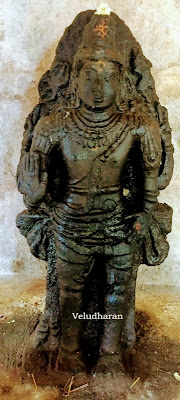
 Ambal Temple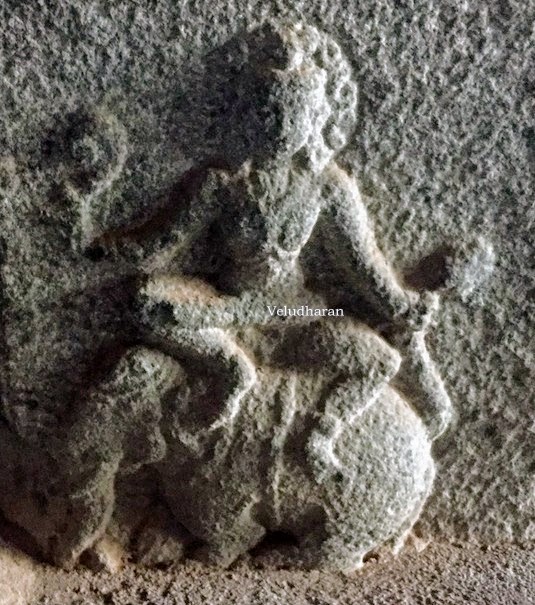

 Dancer's relief stone used on the floor
HISTORY AND INSCRIPTIONSSome experts claim that the original temple belongs
to the Pallava period and was reconstructed as a stone temple during the Chola period. The
temple has contributions from the Rashtrakutas during the middle of the 10th century.
Murugan, Jyeshta Devi, Kalabairavar, and Durgai are believed to be Rashtrakutas sculptures. The temple also has the contributions of Medieval Chozhas, Pandyas, Rashtrakutas, Vijayanagaras, and Nayaks.
The inscriptions recorded from this temple belong to Parantaka-I,
Rajararaja, Rajendran-I, Vikrama Chozha, Kulothunga Chozha-I, Rajadhirajan, Vijayarajendran (Rajadhiraja-I ..? ), Pandya Kings Sundara Pandyan, Kulasekara Pandyan, Pallava kings Koperunjingan, Rashtrakuta King Kannaradevan (Krishna-III), Vijayanagara kings, Sadasiva Maharaya, Achyutadeva Maharaya, Virapratapa Virupakshadeva Maharaya-II, and Vira Narasingaraya.
The inscriptions mainly speak
about donations made to the temple in terms of villages, money, coins, Gold
coins, lands for conducting regular poojas, Naivedyam, and burning of perpetual lamps with the donor’s name. The inscriptions also mention Lord Shiva as “Thanthondreeswarar” and “Thanthondripiran”; then, how this name was changed to the present name of
Jambukeswarar is not known. This place was called “Sambai”, alias “Veerarajendra
Chozhapuram”, also called “Valaiyur”, alias Nottavodapuram in Vanagopadi, alias Madurantaka Valanadu, a part of Jayangonda Chozha mandalam. (Exemption of Tax - Somasulavari to this temple during the Achyutadeva Maharaya period)
Parantaka-I ‘s inscription records the endowment of worship
to the Jyeshta Devi for which a land was gifted. The Jyeshta Devi,
presently in the praharam, was on the
banks of the Temple Tank during the Parantaka Chozha period.
Parantaka Chozha-I’s 34th reign year inscription
records the endowment of the construction of
a Mandapa, Maintenance, and burning of a
perpetual lamp by Viranaraniyar, consort of Gandaradita and daughter-in-law of
Chozhamadeviyar, in the name of “Nagarattar valaiyur”. For the same 70 kalanju, Gold was gifted.
Parantaka-I’s inscription records the sacred bath on Sankranti days of Tanthondriappar at Valaiyur. Similarly, a fragment
inscription records the endowment of burning a perpetual lamp in front of
Vidividangar (processional deity) by Ayyaradigal, a headman of Irayankudi. Another inscription records the endowment of
burning 5 perpetual lamps for which 50 Kalanju Gold was gifted. Rajaraja-I’s
28th reign year inscription starts with his meikeerthi and records a
gift of 10 Kalanju of gold deposited with the urar / villagers sabha of Palaippandal
on the southern bank, for a perpetual lamp in the temple by a merchant of the
village by name Angadi Porraman for (the memory of) one piratti Siralan of
Munaippadi Navalur. The reason for the gift is stated to be that the latter
trespassed into the former’s house in the night and tried to assault his
mistress in his very presence, by which he was enraged so much as to stab the intruder to death.
Rajaraja-I’s 24th-year inscription records the
grant of 20 Servu lands by the Sabha of
Nerkunram alias Vairamegha Chaturvedimangalam, urar to the user of Kolliyur in
exchange for lands acquired, on their behalf, from the latter by the Rajaraja Vanakovaraiyar for the
construction of a tank called “araiyagal–adittapereri” in their Village. The amount of taxes to be given to the King by
the Urar was fixed as 1000 kalanju Gold.
Kulothunga Chozha's (III) 3rd reign year inscription records the gift of 64 sheep (..?) for burning two perpetual lamps. One Pallicheriyadiyan Nambiyan alias Kovalarayaperaraiyan happened to wound fatally accidentally another man Pennai Vadakarai Chengundra Nattu Valaivetti, Velalan Pon PaRRiyudayan Kundran Seerudayan, and the people of 19 Nattu Chitramezhi Nattars met, threw the blame on him, and ordered to endow 64 Sheep (Saava Moova Peradus/ ewes) for burning two lamps (67 / 1906).
Vikrama Chozha's period inscription records the endowment of burning a lamp for the reason being... A man apparently pushed his wife, as a result of which she fell and died. The 1500 men of the four quarters declared him guilty in their assembly and compelled him to provide for lamps.
Vikrama Chozha's 9th reign inscription records the gift of 64 Cows for two lamps, by a man who, in the course of a comparison of martial skill with two vellalas, killed one of them.
The Chozha King Rajakesarivarman alias Udaiyar Sri Virarajendradeva (1063- 1070 CE), an inscription records the gift of 500 Kulis Land to the account of Rajendrapura by the temple authorities to the temple account, among whom figures the Mahavratin Lakulisvara Pandita as the head of the pujaris. This Pujari name figures in the Melpadi inscription, of Rajendra Chozha-I (SII Vol -III, page 28) and Beligami inscriptions 9 Epic Indica Vol -V p 227), perhaps all these were the same. Lakulisvara Pandita was evidently a Kalamukha. (A Lakulisvara's idol is in the praharam) Vanakovarayan Rajarajadevan Vannenjarayan’s 11th
reign year inscription records that Kasayam, Ponvari, Alamji, and Antarayam tax exemption was given to the Village Gunamangalam, which belongs to this
“Tiruttantonri Avudaya Nayanar”.
There are 5 Pandya Kings' inscriptions recorded from this temple. They belong to Kulasekara Pandya (3), Maravarman Vikrama Pandyan, and Sadayavarman Sundara Pandyan. Kulasekara Pandya's inscription records the taxes to be paid depending on the crops raised. like, Nanjai, Beetle Nut leaves, Ginger, Turmeric, Samai, El, Kol, Alasanthi Payiru, etc.
The Kulasekara Pandya's 33rd reign year inscription records that due to a shortage of funds, amounts to 31 Panam for conducting Thiruvizha and maintenance, so the trustees gave lands belonging to the temple as Kani to Thirukotti Alwan Periyan Eeswara Battan, who belongs to Manalur. Another Vanakovarayan Rajarajadevan Vannenjarayan’s 11th
reign year inscription records that agreements were made by the Siva Brahmins to
provide paddy offerings to gods on two festival days and also feeding for Maheswaras with the offered food from the interest of 60
kalam paddy measured on the “Tonro Marakkal”, received from Arasan Tiruttonda
Nambi, a Devakanmi, belongs to the temple Udayar Thiruvannamalai Udaya Nayanar (Lord Shiva of Thiruvannamalai).
Koperunjingan’s
13th reign year (119 of 1906) inscription records that a tax-free land of 150 Kuli by the
Thanathar for this temple, according to the order of Gangayan, a small region leader to Annamalai, the
younger brother of Atkondan, who cut off his head so that the nirutha mandapa ( நிருத்த மண்டபம் ) in
the temple of Tirttantonri Aludaiya Nayanar at Sambai might be completed.
Atkondan is stated to be the younger brother of Porralvi, Thevaradiyal (temple
maidservant) residing in the Village. (This inscription is for an instance of
Voluntary sacrifice for the successful completion of a Mandapa.) A land measuring 150 Kuzhi was gifted to Annamalai. (119 / 1906 - SII Vol XII-178).

 Navakanda Hero StonesKoperunjingan’s 14th reign year inscription
records the endowment of offerings to the God Thanthondri Aludaya Nayanar, on
the 7th day of the annual festival, by Mulaiyanudaiyan Ponparappinan
Kovalrayan, for which 10 Kalam paddy was received by the trustees (thanaththar) of this temple.
Navakanda Hero StonesKoperunjingan’s 14th reign year inscription
records the endowment of offerings to the God Thanthondri Aludaya Nayanar, on
the 7th day of the annual festival, by Mulaiyanudaiyan Ponparappinan
Kovalrayan, for which 10 Kalam paddy was received by the trustees (thanaththar) of this temple.
Koperunjingan’s 16th reign year inscription
records the endowment of a special pooja called “Vennenjan Thirunal”, in the
month Purattasi (August – September), from the income of the paddy assigned by
Vannenja Nayanar, which is the chief of Vanakovarayan Rajadevan Vannenjan of
Aragalur, a subordinate to Koperunjingadeva.
Rajendran-II's 3rd reign year inscription records that a lady Veerabhudra's mother Sendhan Umayal was compelled to pay the Taxes by the Village official Malaiyaman Katti Meloorudayan Pazhanguran Kundran. When she was unable to pay, he told her that he would report to the King. Due to this, she consumed poison and committed suicide. On verification by the "Nangu Thisai Pathinenbhoomi NanadesikaL", the Village officer was found guilty and, as a punishment, he was ordered to burn a
perpetual lamp at this temple, for which 32 kasu was received from the Village official. It was agreed that 2 parts of the required oil would be supplied by the Manigrama Villagers and one part by the Sankarapadi Villagers. (80 / 1906)
Ref: 1. South Indian Inscriptions, Volume-XII.2. Annual Report on South Indian Epigraphy, Year 1906.
Maha Kumbhabhishekam was conducted on 2nd February 2025.  Inscriptions
LEGENDSDevotees worship Lord Shiva and Ambal for the Child boon, to get rid of Rahu & Ketu Dosham to remove marriage obstacles.
POOJAS AND CELEBRATIONSApart from regular poojas, special poojas are conducted on
Pradosham, Amavasya, Thai Pongal, Maha Shivaratri, and Karthigai Deepam.
TEMPLE TIMINGS:Since the temple is under renovation, the time of opening and
closing is unpredictable.
CONTACT DETAILS:Venkatesan 9443815936, Shanmugam +91 9965206975, and Elumalai
+91 9597140997 may be contacted for further details.
HOW TO REACH:Jambai is about 19 km from Thirukovilur and 25 km from
Thiruvannamalai.The nearest Railway Station is Thirukovilur.
LOCATION OF THE TEMPLE: CLICK HERE


 Vinayagar and Lakulisar ( Lakulisar was identified as Bhairavar, and this was also brought from Melai Chalukya as a Victory trophy )
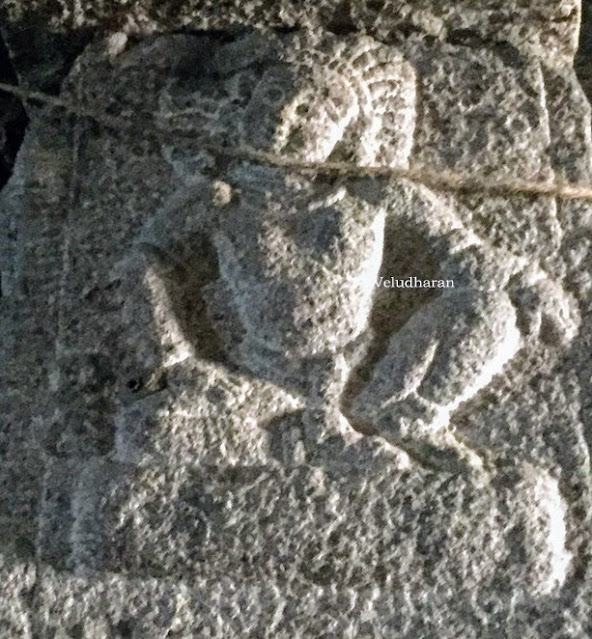
 Dancers' relief stone slab used on the floor
 Mahisasuramardini ( brought as a victory trophy from Melai / Kalyani Chalukyas by Rajendra Chozha's first son )
 Thavvai /தவ்வை/ Jyeshta Devi - 9th to 10th Century ( Parantaka Chozha period inscription records the endowment of burning 2 perpetual lamps )--- OM SHIVAYA NAMA ---


Pallava pillars (9th to 10th century)


Donors at the entrance

Donors at the entrance

Ambal Temple


Dancer's relief stone used on the floor


Navakanda Hero Stones


Vinayagar and Lakulisar ( Lakulisar was identified as Bhairavar, and this was also brought from Melai Chalukya as a Victory trophy )


Dancers' relief stone slab used on the floor


Mahisasuramardini ( brought as a victory trophy from Melai / Kalyani Chalukyas by Rajendra Chozha's first son )

Thavvai /தவ்வை/ Jyeshta Devi - 9th to 10th Century ( Parantaka Chozha period inscription records the endowment of burning 2 perpetual lamps )
Subscribe to:
Posts (Atom)