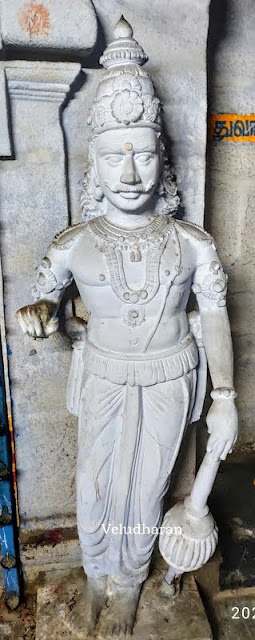
Showing posts with label Thiruvannamalai. Show all posts

Thursday, 24 February 2022

Sri Sugar Narayana Perumal Kovil / Chozha Kerala Vinnagaram, Salukkai, Thiruvannamalai District, Tamil Nadu.

The visit to this Sri Sugar Narayana Perumal Temple at Salukkai was a part of Shiva and Vishnu Temples, sculptures like Kotravai, Jyeshta Devi, Hero Stones, Buddha bas-reliefs at Kanchipuram, Purisai, Kilkolathur, Salukkai and Anumanthandalam on 2nd January 2022. I extend my sincere thanks to Mr. Babu Mano, Mr. Manoj  L Chakravarthy, Mrs. Ruth, சுகுமார் அருள் and the members of “தொண்டை மண்டல வரலாற்று ஆய்வு சங்கம்” for taking me to all these Temples and Heritage sites. 
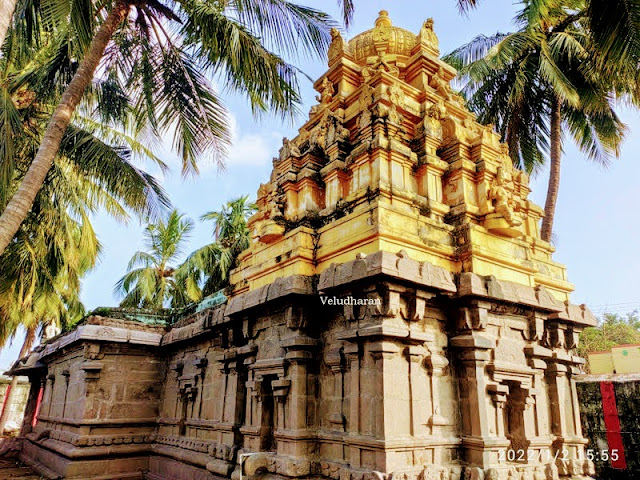

Moolavar  : Sri Sugar Narayana Perumal
Thayar     : Sri Sugunthavalli Thayar

Some of the salient features of this temple are….
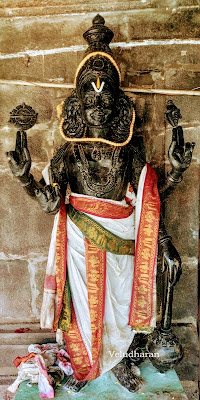
The temple faces east with a Deepa sthambam (bas-reliefs of Anjaneyar and Garudan are at the base) and an entrance arch on the south side with Maha Vishnu’s dasavatar stucco images.  An Anjaneyar Sannidhi is facing the main temple. After a small entrance, balipeedam, Thulasi madam, kodimara base, and Garudan. Moolavar is believed to be of swayambhu. Moolavar is with Sridevi and Bhudevi. There are no images in the koshtam. Utsava murtis are in antarala. Thayar Sugunthavalli and Andal are in the Ardha Mandapam.

In praharam Sri Varadaraja Perumal with Sridevi and Bhudevi, Alwars, Garudan, and Balipeedam. 
 
ARCHITECTURE
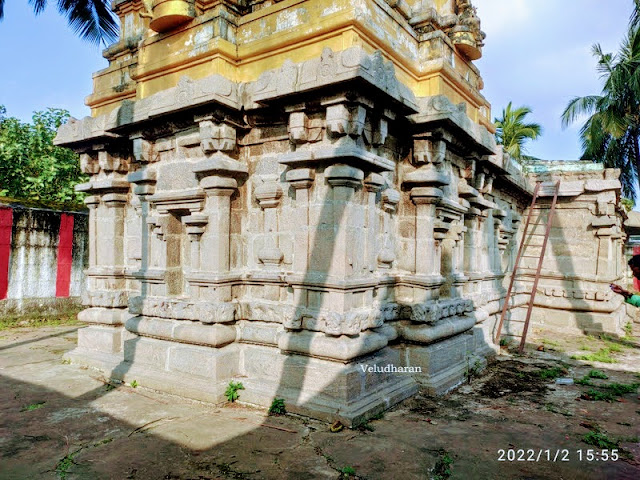
The temple complex consists of a sanctum sanctorum, antarala, ardha mandapam, and a maha mandapam. The sanctum sanctorum is on a prati bandha adhisthana with vrutha kumuda.  Koshtas, salaipathi, and karnapathi are separated by Vishnu kantha pilasters. The pilasters are with Kalasam, kudam plain mandi, palakai, and vettu pothyal. Pancharas are between salaipathi and karnapathi. Sala koshtas are protruding outside as padra sala. The mahara thoranas are plain, and no images were found.

The bhitti starts with vedikai. The prastaram is with valapi, kapotam with nasi kudus, and bhoomi desam. Vyalavari may be missing during renovations. A stucco vesara vimana is over the bhoomi desam. The vimanam does not have images except in the salas.

The front mandapam was built during the Vijayanagara period. The temple was reconstructed during the Vijayanagara period, and its inscriptions are found in the adhistanam.


HISTORY AND INSCRIPTIONS
The original temple belongs to the 1069 CE Chozha period. Chozha Keralan was the Second son of Rajendra Chozha I. His original name was Manukulakesari (from the inscriptions Manukulakari is available with Chozha Keralan. Manukulakesari means the descendant of Manuneethi Chozha and Kesari, like a Simham. In 1018 CE, he was appointed as ruler of Kerala, hence called Chozha Keralan. Chozha Keralan, alias Jayamallan (a title, since he conquered Chalukya King Jayasimhan, in the 1021 CE war), died before 1033 CE, maybe in a war after 1021 CE. As per Ila Thiyagarajan, the Jayamalleeswaram at Vashitapuram is a pallipadai temple of Chozha keralan. Historians like V G Srinivasa Rao, V Rengachari, and Kudanthai N Sethuraman, who was Chozha Keralan. As per Ila Thyagarajan, the fragment inscription recorded from Vashistapuram and considering the period of the Kalithindi war, Chozha Keralan was the Second Son of Rajendra Chozha-I and younger brother to Rajadhirajan-I and Veera Rajendran. 

This place was called different names, such as Salukkai alias Chozhakeralapuram, a business town, Salukki Kulakalapuram, and  Manukulakesarinallur,  in memory of Chozha Keralan.  The Maha Vishnu Temple was called Chozha Kerala Vinnagar.  This Maha Vishnu temple was constructed during “Veerarajendran”, also called “Chozha Lingeswaran”,  the third brother of Chozha Keralan, in memory of his brother.

Krishnadeva Maharaya's saka year 1441, year inscription at Sri Manukulakesari Iswaram Udayar temple, records the remission of Tax of 20 pon as sarvamanya to the two temples, ie, to this Shiva Temple and the Chozha Kerala Vinnagaram Emperumanar of Salukkai alias Chozha Keralapuram, from the administrative control of Vandavasi Sirmai to Veerabhadraraya sirmai. for the expenses connected to offerings, worship, and festivals in these two temples.

The Pandya King Maravarman alias Thirubhuvana Chakravathi Kulasekara deva's 40th reign year inscription records the gift of lands as Tax-free in the village of Kudiningada Tiruvidayattam to the God Chozha Kerala Vinnagaram Emperuman by the residence of Salukkai alias Chozha Keralapuram.

The Pandya King Thiribhuvana Chakravarthi Konerimai Kondan's (13+1), 14th reign year inscription records endowment of naivedyam for Kothandaraman sandhi for the same in the 4 periphery limit of Veerambakkam village, lands which include Nanjai and Punjai after exempting the taxes like Keetruvari, Ponvari, nattuvari, Thattarpattam, etc.

The Thiribhuvana Chakravarthi Rajendra Chozha Deva's 8th reign year inscription records that the Pondai Matrupuli of Venkundra Kottam consecrated the images of Chozha Kerala Vinnagaram Emperuman of the Western temple, Manukula mahadeva Iswaram Udaiyar of Sri Kailayam (Temple), Veerakeralap Perumpalli (Uttara Devi) and Ambala Nangai as a protection for the City (Salukkai) and Made Provision for the worship, offering, Lamps, and nandavanam / flower Garden in the first two temples mentioned above and also made Gift of land to all the temples assigning the Villages of Erumbur, Kurumbur Veeraperumbakkam, and Illuppai. The servants required for these temples were also given house sites. 

One of the 16th-century Vijayanagara-period inscriptions records the construction of Thirumandapam, Sobanam Thiruvasal / entrance. In that, Maha Vishnu’s name is clearly mentioned as Chozha Kerala Vinagaraperumal.


LEGENDS
It is believed that Suga Brahmarishi and Bharadwaja worshipped Sri Sugar Narayana Perumal of this temple.
Devotees worship Perumal and Thayar for a child's boon. And as a part of thanksgiving, thulabharam is offered in this temple.

POOJAS AND CELEBRATIONS
Apart from regular poojas, special poojas are conducted on Vaikasi, Purattasi Saturdays, Vaikunta Ekadasi, Pavithrotsavam in the month of Thai, etc. 

TEMPLE TIMINGS
The temple will be kept open from 07.00 hrs to 10.00 hrs, and from 17.00 hrs to 19.00 hrs.

CONTACT DETAILS
Srinivasa Bhattacharya may be contacted on his mobile numbers +91 9486369874, +91 9677084196, and +918610140553 for further details.

HOW TO REACH
This place, Salukkai, is about 2 km off from Tiruvannamalai to Kanchipuram Main Road, 7.2 km from Vandavasi, 21 km from Cheyyar,  39 km from Kanchipuram,  57 km from Chengalpattu and 113 km from Chennai Central.
The nearest Railway Station is Kanchipuram.

LOCATION OF THE TEMPLE: CLICK HERE


Sri Varadaraja Perumal


--- OM SHIVAYA NAMA ---

Tuesday, 22 February 2022

Hero Stones at Purisai, Thiruvannamalai District and Anumanthandalam in Kanchipuram District, Tamil Nadu.

The visit to these Hero Stones at Purisai and Anumanthandalam was part of the Shiva and Vishnu Temples, and sculptures like Kotravai, Jyeshta Devi at Purisai, Kilkolathur, Salukkai, and Anumanthandalam on 2nd January 2022. I extend my sincere thanks to Mr. Babu Mano, Mr. Manoj L Chakravarthy, Mrs. Ruth, சுகுமார் அருள், and the members of “தொண்டை மண்டல வரலாற்று ஆய்வு சங்கம்” for taking me to all these Temples and Heritage sites. 

HERO STONES AT PURISAI.
There are two Hero Stones installed at the entrance of Sri Ellai Amman Temple at Purisai. Of these two Hero stones, one is smaller, and the other is a little bigger.

In the smaller hero Stone, the hero is in a three-bhanga standing posture, looking straight ahead. He is holding a sword in his right hand and a shield in his left hand. The legs are shown as the hero is marching forward on the left side. A dress is shown below his waist. He is wearing ornaments on his neck and ears.  The dress is shown below his waist. A Vijayanagara-style tuft is shown on his head. The hero may be a warrior.

In the bigger hero stone, the hero is in a three-bhanga standing posture. He is holding a sword in his right hand and a bow in his left hand. The legs are shown as the hero is marching forward on the left side. The dress is shown below his waist. He is wearing ornaments on his neck and ears. A Vijayanagara-style tuft is shown on his head. The Hero may be killed during a war or in the process of saving his cattle (Anirai meetal). 

Both the hero stones may belong to the 16th to 17th century.   

LOCATION OF THE HERO STONE: CLICK HERE


HERO STONE AT ANUMANTHANDALAM
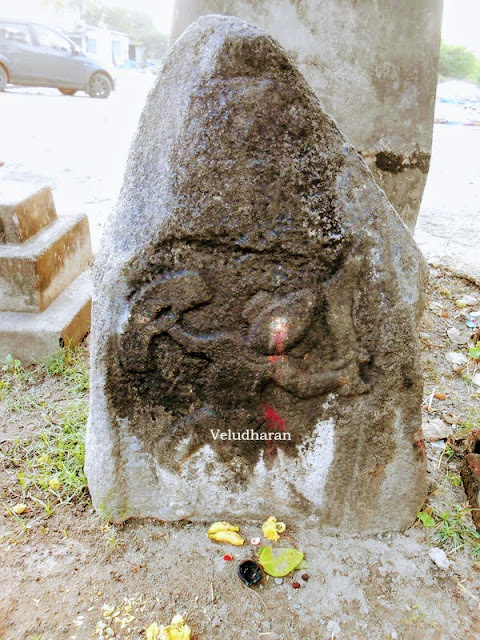
This hero stone is installed in this village. The Hero is shown in three bhanga standing postures, holding a Sword in the left hand and a shield in the right hand. The sword looks similar to Gangar period Swords. A straight tuft is shown on his head, and he is wearing ornaments on his neck and ears. His legs are shown such that he is marching in the right direction. Also, from holding the sword, we may presume that the Hero is a left-hander. He might have died in a war.

This hero stone belongs to the Gangar period, 08th – 09th century CE.

LOCATION OF THE HERO STONE: CLICK HERE


--- OM SHIVAYA NAMA ---

Sunday, 20 February 2022

Manukula Mahadeva Eswarar Temple / Manukula Kesari Eswaram / Lord Siva Temple, Salukkai, Thiruvannamalai District, Tamil Nadu.

The visit to this Sri Manukula Mahadeva Eswarar Temple at Salukkai was a part of Shiva and Vishnu Temples, Sculptures like Kotravai, Jyeshta Devi, Buddha bas-reliefs at Kanchipuram, Purisai, Kilkolathur, Salukkai, and Anumanthandalam on 2nd January 2022. I extend my sincere thanks to Mr. Babu Mano, Mr. Manoj  L Chakravarthy, Mrs. Ruth, சுகுமார் அருள் and the members of “தொண்டை மண்டல வரலாற்று ஆய்வு சங்கம்” for taking me to all these Temples and Heritage sites.


Moolavar  : Sri Manukula Mahadeva Eswarar
Consort    : Sri Maragathavalli

Some of the salient features of this temple….
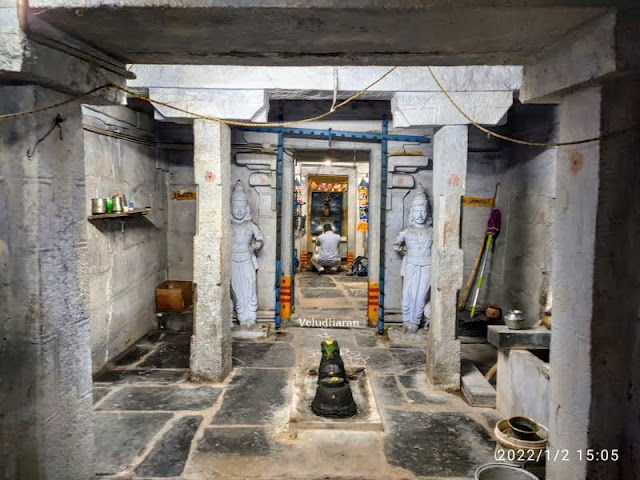
The temple faces east with an entrance arch. Stucco images of Vinayagar, and Lord Shiva with Parvati as Rishabaroodar and Murugan are on the top of the entrance arch. Vinayagar, balipeedam and Rishabam are after the entrance arch. There is also another entrance (with Vinayagar and Murugan on both sides) on the south side, just opposite the Ambal sannidhi. Stucco dwarapalakas are at the entrance of the sanctum sanctorum. Ambal sannidhi is in the ardha mandapam. Moolavar is of swayambhu on a round avudayar. Rishabam, balipeedam, and Nalvar  are in the ardha mandapam. In koshtam Vinayagar, Dakshinamurthy, Maha Vishnu, Brahma, and Durgai.

In praharam Vrahi, Varasiddhi Vinayagar, Pichadanar, Rishabam, Lingas, Chandikeswarar, Nagar, Valli Devasena Subramaniar, Bhairavar, and Navagrahas.

ARCHITECTURE
The temple complex consists of the sanctum sanctorum, antarala, ardha mandapam, and a mukha Mandapam / Sobana mandapam. The entrance to the ardha mandapam is  from the east and south directions. The adhistanam is on a raised upana. A pirathi bandha adhistana is on the upana, with jagathy, vrutha kumuda, kapotam, and viyyalavari. A Pancharam is in the  Aharai or the saleelantharam (between salaipathi and karna pathi). The Pancharam is on a padma bandha adhisthana.  The Bhitti salaipathi and karna pathi are separated by Vishnu kantha pilasters with square base malai thongal, thamarai kattu, kalasam, kudam, thadi mandi (Lotus petals), palakai, veerakandam, and Vettu pothyals.

The prastaram is with utharam valapi, kapotam, and vyyalavari. Bhuta ganas are in the valapi. The first level vimanam was built with stone, which includes the thala vahana. The greevam and the Dravida sigaram with 8 faces were built with stucco. Maha nasis is in the cardinal direction. The salai and Greeva koshtas are with the images of Lord Shiva, Dakshinamurthy, Maha Vishnu, and Brahma.

The temple was reconstructed during the Vijayanagara period. And their inscriptions are found in the adhistanam.


HISTORY AND INSCRIPTIONS
The original temple belongs to the 1069 CE Chozha period. Chozhakeralan was the Second son of Rajendra Chozha I. His original name was Manukulakesari (from the inscriptions Manukulakari is available with Chozha Keralan. Manukulakesari means the descendant of Manuneethi Chozha and Kesari, like a Simham. In 1018 CE, he was appointed as ruler of Kerala, hence called Chozhakeralan. Chozha Keralan, alias Jayamallan (a title, since he conquered Chalukya King Jayasimhan, in the 1021 CE war), died before 1033 CE, possibly in a war after 1021 CE. As per Ila Thiyagarajan, the Jayamalleeswaram at Vashitapuram is a pallipadai temple of Chozha keralan. Historians like V G Srinivasa Rao, V Rengachari, and Kudanthai N Sethuraman, who was Chozha Keralan. As per Ila Thyagarajan, the fragment inscription recorded from Vashistapuram, and considering the period of the Kalithindi war, Chozha Keralan was the Second Son of Rajendra Chozha-I and younger brother to Rajadhirajan-I.  

This place was called different names, such as Salukkai alias Chozhakeralapuram, a business Town, Salukkai Kulakalapuram, and Manukulakesarinallur,  in memory of Chozhakeralan. The Shiva temple was Manukulakesari Eswaram. This Shiva Temple was constructed during “Veerarajendran”, also called “Chozha Lingeswaran”, the third brother of Chozha Keralan, in memory of his brother. The name of Lord Shiva as “Manukesari eswaram was maintained till the 16th-century Vijayanagara period.

The Tribhuvana Chakravarti Rajendra Chozha Deva's 8th reign year inscription records that the Pondai Matrupuli of Venkundra Kottam consecrated the images of Chozha Kerala Vinnagaram Emperuman of the western temple, Manukula mahadeva Iswaram Udaiyar of Sri Kailayam (Temple), Veerakeralap Perumpalli (Uttara Devi) and Ambala Nangai as a protection for the City (Salukkai) and made provision for the worship, offering, Lamps, and nandavanam / flower garden in the first two temples mentioned above and also made gift of land to all the temples assigning the villages of Erumbur, Kurumbur Veeraperumbakkam, and Illuppai. The servants required for these temples were also given house sites. 

Vikrama Chozha's 4th reign year inscription records the endowment of burning a sandhi lamp, Naivedyam Milakamuthu, Neiyyamuthu, Thayiramuthu, Adaikayamuthu, Beetle nut leaves  10 nos,  for the same 4 kasu for naivedyam and 2 Kasu for Sandhi lamp gifted by Thiruvalavayudayan. 

Krishnadeva Maharaya's saka year 1441 records the remission of the Tax of 20 pon as sarvamanya to the two temples, ie, to this Shiva Temple and the Chozha Kerala Vinnagaram Emperumanar of Salukkai, alias Chozha Keralapuram, from the administrative control of Vandavasi Sirmai to Veerabhaadraraya Sirmai, for the expenses connected to offerings, worship, and festivals in these two temples.

The Pandya King Maravarman alias Tribhuvana Chakravarti Kulasekara Deva period inscription records the gift of the village Murukkeri in SalikkaippaRRu as a Tax-free Devadhana to this temple of Aludayar Manukulakesarieswaram Udaya Nayanar for worship and Thirupani / repair works.

Kulothunga Chozha-I's 49th reign year inscription starts with meikeerthi as "புகழ்மாது விளங்க...." records the sale of 2 Veli land as devadhana by the merchant guild of Chozhakeralapuram, a city of Venkunra nadu, a division of Venkundra Kotta, in Jayangonda Chozha Mandalam to Sundari Udayanjeyda alias Puvendiya Chozha Manikkam, a dancing girl attached to this temple Manukulakesari Iswaram Udayar,  for setting up the image of Tiruppalliyarai Nampiratiyar and for offering to and for burning a perpetual lamp before the image.

An incomplete inscription of Rajakesarivaram Thiribhuvana Chakravarti alias Kulothunga Chozha's 3rd reign year inscription starts with his mei keerthi as "பூமேவி வளர..." records the sale of land.    

The present trustee has spent around 11 Lakhs from his personal fund towards the maintenance of this temple.


LEGENDS
Devotees pray to Lord Shiva and Ambal to remove marriage obstacles and marriage boon.

POOJAS AND CELEBRATIONS
Apart from regular poojas, special poojas are conducted on pradosam and Mahashivaratri days.

TEMPLE TIMINGS
The temple will be kept open from 07.00 hrs to 09.00 hrs, and from 17.00 hrs to 19.00 hrs.

CONTACT DETAILS
Gurukkal Balakrishnan may be contacted on his mobile at +919786376572 for further details.

HOW TO REACH
This place, Salukkai, is about 2 km off from Tiruvannamalai to Kanchipuram Main Road, 7.2 km from Vandavasi, 21 km from Cheyyar,  39 km from Kanchipuram,  57 km from Chengalpattu, and 113 km from Chennai Central.
The nearest Railway Station is Kanchipuram.

LOCATION OF THE TEMPLE: CLICK HERE


Chandikeswarar
Maha Vishnu and Bhairavar
Bhairavar
Chandikeswarar
Varahi
--- OM SHIVAYA NAMA ---

Friday, 18 February 2022

Sri Agastheeswarar Temple / Lord Siva Temple, Kilkolathur, Thiruvannamalai District, Tamil Nadu.

The visit to this Sri Agastheeswarar Temple at Kilkolathur, in Thiruvannamalai District, was a part of Shiva and Vishnu Temples, Sculptures like Kotravai, Jyeshta Devi at Purisai, Kilkolathur, Salukkai and Anumanthandalam on 2nd January 2022. This temple is a little away from the village, in the midst of the Sugarcane and Paddy fields. I extend my sincere thanks to Mr. Babu Mano, Mr. Manoj  L Chakravarthy, Mrs. Ruth, சுகுமார் அருள் and the members of “தொண்டை மண்டல வரலாற்று ஆய்வு சங்கம்” for taking me to all these Temples and Heritage sites.


Moolavar  : Sri Agastheeswarar
Consort    : Sri Akilandeswari

Some of the salient features of this temple are…..
The temple faces east with a balipeedam and a Rishabam. There is no entrance arch or Rajagopuram, and a compound wall. The entrance to the sanctum is from the south side with a mukha mandapam. Stucco images of Lord Shiva with Parvati are on the top of the Mukha mandapam. Moolavar is a little large. In koshtam Vinayagar, Dakshinamurthy, Maha Vishnu, Brahma and Durgai.

Old Rishabam and balipeedam are kept outside the temple. Bhairavar, an Amman (A Bhuthaki and Ayyanar are installed as koshta murtis), Navagrahas, Nagars, a loose sculpture of Dakshinamurthy (Chozha Period), and Chandikeswarar are outside the temple. Ambal is in a separate sannidhi in the ardha mandapam. Amman is in a standing posture with abhaya and varada hastam.

ARCHITECTURE
The original temple belongs to the Chozha period, and the same was reconstructed in recent years without following any temple structure norms.

The sanctum sanctorum is on a three-anga adhistana. A two-tier stucco vesara vimana is in the sanctum sanctorum. Stucco images of Dakshinamurthy, Maha Vishnu, Brahma, Ardhanareeswarar, Nandi Bhagwan, Lingothbavar, Vinayagar, and Murugan are in the Greeva koshtam. Agasthiyar stucco image with Raishabams on both sides on the Ardha mandapam parapet wall to remind the name of Lord Shiva as Agastheeswarar.

The ardha mandapam is on a simple pada bandha adhistanam. A hole is provided on the east wall for Rishabam to view Moolavar. The mukha mandapam and ardha mandapam are built using the old stones removed from the original temple. The walls are supported by Brahma kantha pilasters with vettu pothyal without any ornamental work. The south side mukha mandapa pillars are original.


HISTORY AND INSCRIPTIONS
The original temple belongs to Rajaraja Chozha-II (Rajendra Chozha’s son), and the same was reconstructed in recent years. During reconstruction, the inscription stones are used in different places, hence there is no continuity. The Chozha period and Vijayanagara period inscriptions record the gift of Lands, etc, for poojas, naivedyam, and burning lamps.   

Ashtabandhana maha kumbhabhishekam was conducted on 18th February  2019 after renovations.


LEGENDS
In another legend, it is believed that this is one of the 108 Shiva Lingas installed and worshipped in Thondai mandalam by Agasthiyar on the way to Pothigai Hills to balance the earth during Shiva and Parvati’s celestial wedding.

The devotees worship Lord Shiva for removing Marriage obstacles, Child boon, etc.

POOJAS AND CELEBRATIONS
Apart from oru kala pooja, special poojas are conducted on pradosam and Maha Shivaratri days. 

TEMPLE TIMINGS
Since oru kala Pooja is conducted, the temple will be kept open during morning hours, and the time is predictable.
CONTACT DETAILS
 
HOW TO REACH
The village Kilkolathur and the temple are about 2 km off Cheyyar-Vandavas – Polur Road, 9.8 km from Cheyyar, 18.5 km from Vandavasi, 40 km from Kanchipuram, 58 km from Chengalpattu and 114 km from Chennai Central Station.
The nearest Railway Station is Kanchipuram.

LOCATION OF THE TEMPLE: CLICK HERE
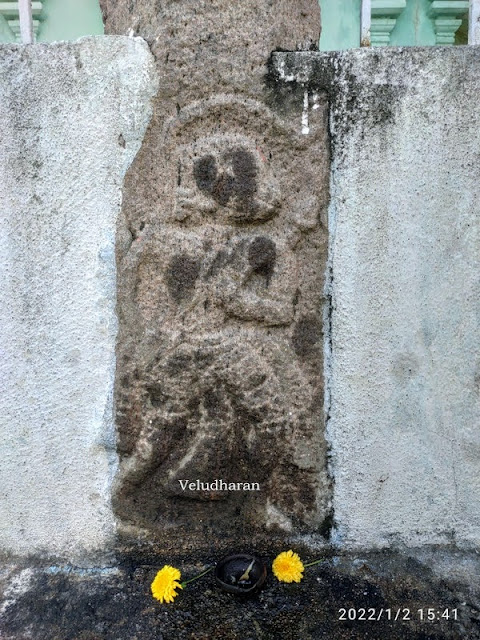


Agasthiyar in place of Bhutagana


Moolavar sanctum sanctorum

Chozha period Dakshinamurthy
Ayyanar
--- OM SHIVAYA NAMA ---