Showing posts with label Ranipet. Show all posts

Tuesday, 1 February 2022

Sri Muktheeswarar Temple / ஸ்ரீ முக்தீஸ்வரர் கோயில், Kaveripakkam, Ranipet District, Tamil Nadu.

The visit to this Sri Muktheeswarar Temple at Kaveripakkam was part of the Shiva and Vishnu Temples and Heritage sites at Thirumalaicherry, Gudimallur, and Kaveripakkam. I extend my sincere thanks to Mr. Ramesh Krishnamurthy for taking me to all these places. This temple is believed to be one of the Mukthi sthalam.


Moolavar  : Sri Mukhtheeswarar, Sri Vedapureeswarar
Consort    : Sri Alangaravalli

Some of the salient features of this temple are….
The temple faces east with a 5-tier Rajagopuram on the south side. Stucco images of Lord Shiva with Parvathi, Vinayagar, and Murugan are on the top of the maha mandapam south side entrance. Balipeedam, dwajasthambam, and Rishabam / idabam are on the east side of the temple. It is claimed that the Moolavar in  the sanctum looks like swayambhu, but it is not so on a round avudayar. Stucco Dwarapalakas are at the entrance of the sanctum sanctorum. In koshtam, Vinayagar, Dakshinamurthy, Lingothbavar, Brahma, and Durgai. In the praharam, Vinayagar, Sri Valli Devasena Subramaniar, Nalvar, Bhairavar, Pancha Lingas,  and Navagrahas (Rahu on a tortoise and Shani Bhagwan on an Eagle vahana).

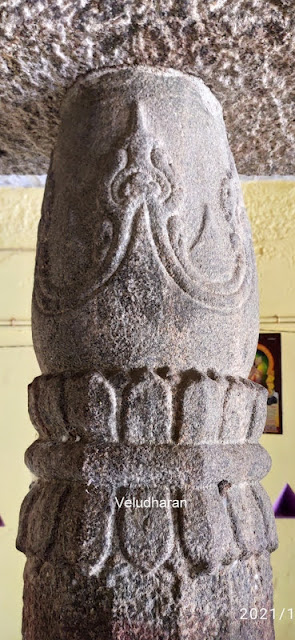
Ambal is in a separate sannidhi in the maha mandapam. Images are in the koshtams of Ambal Sannidhi. In the outer praharam, Dashabhuja Vinayaka Sannidhi, a Vinayagar sannidhi, Kalyana mandapa, a Shiva Linga with a Rishabam/Idabam & a part of a Vijayanagar period pillar, and Utharakosai dosha relieving Dhyana mandapam with various stucco images of Kali, etc.   

ARCHITECTURE
The temple consists of the sanctum sanctorum, antarala, ardha mandapam, and maha mandapam. The adhistana is of kapota bandha adhistana with jagathy, threepatta kumuda, and kapotam with nasis. Bhitti starts with vedika, and koshtas are separated by the Brahmakantha pilasters. The pilasters are with malaithongal, kalasam, thadi, kudam, mandi with lotus petals, veerakandam, and vettu pothyal. The 2-tier vimana has stucco images of Dakshinamurthy, Maha Vishnu with Sridevi and Bhudevi, and  Brahma on the 1st level, and Greevam koshtas. The sikaram is of the vesara style with maha nasis on the 4 cardinal directions. 

The ardha mandapam was supported with vrutha pillars and Vettu Pothyal. The Kalyana mandapam and maha mandapam were constructed during the Vijayanagara period. The pillars have bas reliefs of Bhairavar, Pichadanar, Veerabhadra, floral motifs, Shiva Lingas, erotic sculptures, Dancers, Rishis, Vinayagar, Murugan, Maha Vishnu, Hanuman, Ramar with Sita and Lakshman,  Donors, etc. The pillar reliefs are painted colorfully.

The temple was reconstructed, and various structures like horizontal beams and makara torana were used on the praharam walls.


HISTORY AND INSCRIPTIONS
The original temple belongs to the 10th-century Pallava period. Later received contributions from Chozha and Vijayanagaras.
 
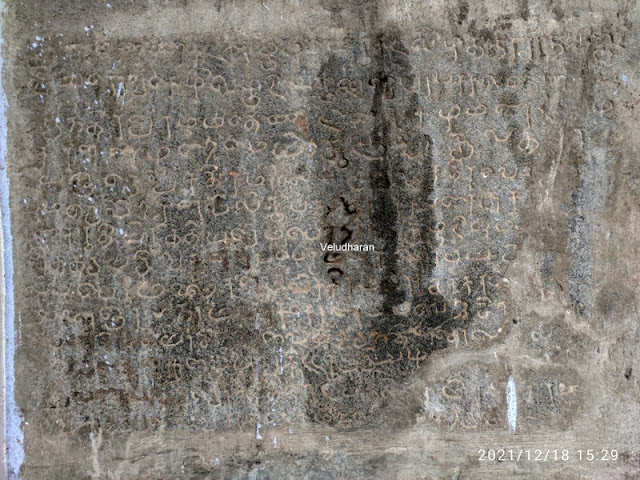
The Pallava King Nandivarman III’s  13th reign year (859 CE) inscription at the entrance into the gopura of the Muktivara temple records (the receipt of) five kalanju (of gold) from the daughter- in-law (marumakal) of Ayyakki Pangala-adigal, (a resident) of the village by somebody (?) (who obviously undertook to supply a certain quantity of oil to the temple)... The uravar of the village is also required to supply daily one alakku of oil.

References :
1. ARE, 1905, no. 406; 
2. South Indian Inscriptions Volume XII.
3. Inscriptions of the Pallavas by T V Mahalingam

Maha kumbhabhishekam was conducted on 1st October 2017.

LEGENDS
It is believed that Seshadri Swamigal came to this temple and was enlightened; hence the original name of Sri Vedapureeswarar was changed to Sri Muktheeswarar.

It is believed that siddhars attained mukti after worshiping Lord Shiva of this temple. Hence, this temple is considered a mukti sthalam, and devotees can do pithru dosham pariharam in this temple.

POOJAS AND CELEBRATIONS
Apart from regular poojas, special poojas are conducted on Pradosham, Maha Shivaratri, New moon days, full moon days, Sankatahara Chaturthi, Kiruthigai, Navaratri, Deepavali, Thai Pongal, Vinayagar Chaturthi, Panguni Uthiram, etc.

TEMPLE TIMINGS
The temple will be kept open from 08.00 hrs to 10.00 hrs, and from 17.00 hrs to 20.00 hrs
CONTACT DETAILS

HOW TO REACH
This temple at Kaveripakkam is about a km from the Madras – Bombay trunk Road / Chennai to Vellore Road / Mumbai Hwy.
The temple is about 10 km from Walaja Toll gate, 11.6 km from Walajahpet, 15 km from Sholinghur, 17.4 km from Arcot, 17 km from Ranipet,  38 km from Vellore, and 95 km from Chennai.
The nearest Railway Station is Sholinghur

LOCATION OF THE TEMPLE: CLICK HERE


--- OM SHIVAYA NAMA ---

Monday, 31 January 2022

Kaveripakkam Lake with 10 Sluice Gates and 2 overflow gutters, Kaveripakkam, Ranipet District, Tamil Nadu.

The visit to this Kaveripakkam Lake at Kaveripakkam was a part of the Shiva Vishnu Temples and Heritage sites at Thirumalaicherry, Gudimallur, and Kaveripakkam. I extend my sincere thanks to Mr. Ramesh Krishnamurthy for taking me to all these places. 


The Kaveripakkam Lake gets its inlet water from the Palar River, and overflow water flows as the Kosathalai River, which splits at the Kesavaram Dam and continues as the Kosathalai River and joins the Bay of Bengal. The diverted water from Kesavaram flows as the Cooum River. The Kaveripakkam lake was excavated during Nadhivarma Pallava-III in the 8th Century. The banks were raised and strengthened at various stages. It was said that the stones of the dilapidated Shiva and Vishnu temples of Kaveripakkam were used for strengthening the banks of this lake during the  British period.

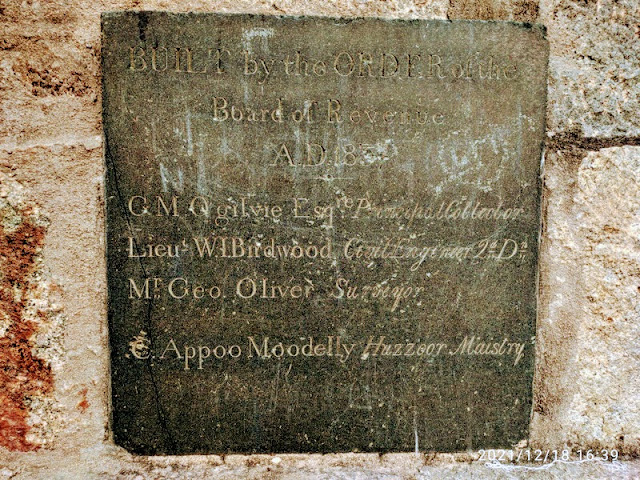
Kaveripakkam Lake holds 1474 million cubic feet of water. The height of the lake is 30.65 feet, the bank length is 8.35 km, and it covers an area of 6.2 square miles (3968 acres). The lake water irrigates about 19500 acres of land. The lake has 10 sluices and 2 overflow structures. 14 villages benefit from this lake's water. In addition to this, the overflow water feeds about 55 small lakes / eris. The overflow water is regulated through 58 big sluices. The 10 sluices that feed water for irrigation are named Nari (Fox) Sluice, Lion Sluice, Palla Sluice, Moola Sluice, etc. The common inscription of all sluices is as follows.

Built by order of the
Board of Revenue 1837
C M Oglive Esqre Principal Collector
Lieu – W.I.Bird wood Civil Engineer 2nd Dn
Mt Geo. Oliver Surveyor
C. Appoo Moodelly Huzzoor Maistry


The sad part is that this Lake is 50% encroached, and the capacity also shrinks due to poor maintenance of the lake and the accumulation of vandalized earth.

HOW TO REACH
This temple at Kaveripakkam is about a km from the Madras – Bombay trunk Road / Chennai to Vellore Road / Mumbai Hwy.
The temple is about 10 km from Walaja Toll Gate, 11.6 km from Walajahpet, 15 km from Sholinghur, 17.4 km from Arcot, 17 km from Ranipet,  38 km from Vellore, and 95 km from Chennai.
The nearest Railway Station is Sholinghur

LOCATION OF THE TEMPLE: CLICK HERE

Overflow shutters 


Sluice 
An encroached banana plantain farm, now submerged underwater
Durga Shrine near Lion Sluice
--- OM SHIVAYA NAMA ---

Saturday, 29 January 2022

Sundara Varadar and Azhagiya Ramar Temple / சுந்தர வரதர் & அழகிய ராமர் கோயில், Kaveripakkam / காவேரிபாக்கம், Ranipet District, Tamil Nadu.

The visit to this Sri Sundara Varadar and Azhagiya Ramar Temple at Kaveripakkam was a part of Shiva, Vishnu Temples, and Heritage sites at Thirumalaicherry, Gudimallur, and Kaveripakkam. I extend my sincere thanks to Mr. Ramesh Krishnamurthy for taking me to all these places. This temple was inside the Kaveripakkam fort and about 300 meters from the Sri Abhaya Varadharaja Perumal temple. This temple is also called Sathya Varadha Kshethram.


Moolavar  : Sri Sundara Varadar
Thayar     : Sri Sundaravalli

Some of the salient features of this temple are…
The temple faces east with a 3-tier Rajagopuram. Deepa Sthambam, Balipeedam, Kodimaram, and Garudan are immediately after the Rajagopuram. Moolavar in the sanctum is about 6 feet tall with 4 hands. Holding Sangu/Conch and Chakra in the upper hands and Lower hands are in abhaya and resting on mace/gadha. There are no murtis in Koshtam. Utsavars Sri Varadharaja Perumal, Sridevi, and Bhudevi are in front of the moolavar. Utsavars are very old compared to Moolavar.

In praharam, Thayar Sundaravalli, Sudarsana & Narasimhar Andal, Alwars, Nigamantha Maha Desigar, Ramar (damaged) in green Stone, unearthed from the temple tank, Nagas and Garuda, and Azhagiya Ramar.

Thayar Sri Sundaravalli is in a separate sannidhi facing the same direction as Perumal

ARCHITECTURE
The temple consists of the sanctum sanctorum, antarala, ardha mandapam, and mukha mandapam. The sanctum sanctorum is on a three-anga adhisthana. The Hemakuta Vimana (Nagara) is over the sanctum sanctorum.

The Thayar sanctum is on a pada bhanda adhisthana with jagathy, virutha kumuda, and pattikai, on a lotus pedestal. The bhitti starts with vedika. The Brahma kantha pilasters are on the wall. The koshtas are empty. The kumudam and jagathy are in green stone. These stones are with Rajaraja-I period inscriptions brought from a dilapidated Temple and do not belong to this temple. The ardha mandapa pillars are also in different styles. Thayar sannidhi is without vimanam.   

One of the specialties of the temple is a jala made out of green stone, which is installed on the south wall of ardha mandapam.


Moolavar Vimanam
Thayar Sannidhi


Pillars of different styles 


HISTORY AND INSCRIPTIONS
As per Gurukkal Narasimhan, the temple was built about 800 years ago. Most of the stones and pillars with Chozha period inscriptions were brought from elsewhere, and the temple was built. There is no relation between the inscriptions and this temple. Some of the inscriptions belong to the Chozha Period, especially Rajaraja Chozha-I. Inscriptions from the 10th Century to the 17th century are found on the wall stones, floor stones, and pillars.     

During Muslim rule, many of the temple’s idols were thrown into the well or buried in the ground. The Azhakiya Ramar was unearthed from the Kottai Perumal temple along with Thayar and Hanuman. Azhikia Ramar was brought to this temple and installed in a separate sannidhi. The Ramar in green stone and granite stone are unearthed from the well and installed in the praharam and ardha mandapam.

As per the history, the war between Raja Sahib with 7000 soldiers and Robert Clive with 500 soldiers was held at this place. Raja Sahib was defeated and killed in the war. It is believed that his body was cut into pieces and thrown in many places.

Mangalasasanam was done by Ahobila Madam 42nd pattam Injimedu Sri Azhagiya Singar, 44 & 45th Azhagiya Singars, Srirangam Periashram Srimad Andan Swami, and Kanchi Kamakoti Chandrasekhara Saraswati Swamigal.

A compound wall was constructed in 2011. Sri Azhagiya Ramar temple, Maha Samprokshanam was conducted on 02nd July 2009.

One of the inscriptions of this Sri Sundara Varadharaja Perumal temple belongs to the Sundara Chozha's 6th reign year. This inscription records the donation of 90 ewes/goats to the Kalapriya Devar Temple by Chambakkan of Kumara Chetti. He owned a shop at Kalapriya Angadi in Paduvur Kottam, Siruthimiri Nattu "Kirthi Marthandam" Nagar. Based on this inscription, some of the experts, like S. R. Balasubramanian, the Kalapriya Marthandam temple might have existed in Kaveripakkam itself and might have been destroyed. However, this was not accepted by KG Krishnan and C R Srinivasan. But this may belong to the Thirumalaicherry Shiva temple. 

References
1. South Indian Inscriptions Volume - VIII.
2. Inscriptions of the Pallavas, by T V Mahalingam.

Rajaraja Chozha's inscription belongs to some other temple


LEGENDS
It is believed that the river Palar flows on the north side of Kanchipuram. The legend applied to Kanchi Athi VaradaRaja Perumal Temple, and Palli Konda Perumal Temple near Vellore is also applied to this temple also since all three temples are on the banks of Palar River / Vegavathi River. The legend goes like this. When Brahma was doing a yagam without Saraswati, she got angry and took the form of the Vegavathi River and flowed with full force to destroy the yaga. At the request of Brahma, Vishnu lay down and stopped the flow of the Vegavathi river. This temple is in the territory of legend, and this temple was once on the banks of the River Palar.

POOJAS AND CELEBRATIONS
Apart from regular poojas, special poojas are conducted on Panguni Uthiram, Avani Thiruvonam, Sri Rama Navami, Chithirai & Panguni Kalyana utsavam, Vaikunta Ekadasi, Margazhi, and Purattasi Saturdays.

TEMPLE TIMINGS
The temple will be kept open from 07.00 hrs to 10.00 hrs, and from 17.00 hrs to 19.00 hrs.

CONTACT DETAILS
R. Narasimhan, who knows the historical background of the temple and Kaveripakkam, may be contacted on Landline, and mobile numbers +91 4177 254522 and +91 9791687534 may be contacted for further details.

HOW TO REACH
This temple at Kaveripakkam is about a km from the Madras – Bombay trunk Road / Chennai to Vellore Road / Mumbai Hwy.
The temple is about 10 km from Walaja Toll gate, 11.6 km from Walajahpet, 15 km from Sholinghur, 17.4 km from Arcot, 17 km from Ranipet,  38 km from Vellore, and 95 km from Chennai.
The nearest Railway Station is Sholinghur

LOCATION OF THE TEMPLE: CLICK HERE

Dwarapalakas
Both Ramars have recovered from the Temple tank 


Azhagiya Ramar Temple


Thayar Sannidhi
Jala is made out of green stone
--- OM SHIVAYA NAMA ---