05, February 2012
On 4th Feb
2012, along with Reach Foundation members went to the following temples near
Kanchipuram. I enjoyed the Tour and learnt many things which are not known
earlier. The tour mainly focused to have more exposure to the early Tamil
scripts chiseled on the walls of the temples and caves. I extend my sincere
thanks to Reach foundation and Mr. Varadharajan who has immense knowledge
about the places and temples. ( He had made short films on Chola kings and
Pallavas for Discovery Channel ). He explained every details of the temples
we visited. We ( 12 peoples ) went to all the places through a van
from Chennai which costs us only Rs 650.00, each including a very good
food for the whole day, packed from Chennai.
On the way we had a darshan
of “Saptamatrikas” at Pazhaya Seevaram on the road side ( Sri Arulmigu
Aartrangarai Amman Thiru Koil ). All are in sitting posture with left leg
folded. The Saptamatrikas and a Pillayar, belongs to Pallava Kings Period
made of Sand stone, since it is on the road side regular poojas are conducted.


There are lot of
Jain temples from Kanchipuram to Arani via Vandavasi built in many
villages. One such place is Karanthai. The temple is very spacious and we found
Pallava period Tamil inscriptions. We were allowed to take
photographs. We found lot of similarities between Hindu temple and Jain
temples. The Rajagopuram and the Moolavar Gopuram are built very similar to
Hindu temples. There are four separate shrines for Sri Munigiri
Digambara, Sri Bramakshan – Sri Bhrama Thevar ( Similar to Ayyappan in
meditation Posture with band on one leg ), Sri Mahavir, 1008 Sri Virukshaba
Natha Bhagwan and Sri Kuhmandini yakshi – Sri Dharma devi.


In Dharma Devi
mandapam paintings were done beautifully on the ceiling. We understand that
there is no abhishekam for the moolavar, since moolavar was made of stucco. There is a navagraha
sannidhi in which the deities are named as follows.
Badma Tirthankara
|
- Suriyan
|
Vaasu Boojya
Tirthankara
|
-Angarakan
|
Varthamana
Tirthankara
|
- Guru
|
Mallinaatha
Tirthankara
|
- Budhan
|
Pushpathantha
Tirthankara
|
- Sukaran
|
Muni Sooviratha
Tirthankara
|
- Sani
|
Chandraprabhu Tirthankara
|
- Santhiran
|
Naemi Tirthankara
|
- Raghu
|
Barkoova
Tirthankara
|
- Kethu
|


The
Jinalaya Gopuram
is of Vesara Style ( some claims as gajabirusta / Gajaprishta Style -
Back of elephant ). In the 1008 Sri Virukshabanatha Gopuram we could see
the
Saraswathi sudhai statue on the top. Since education and Medicine to the
local peoples are the motto in Jainism.

( Saraswathi Temple )


( Murals on the ceiling of Dharma Devi Temple )


( Saraswathi temple )


( Navagraga's sannadhi and the corresponding theerthangaras )


( Rajagopuram is similar to Hindu temples )


DUSI MAMANDUR
There are four rock
cut caves in the Mamandur hills of which two caves were used as shrines
with Pallava Period Tamil inscriptions. The total site is under the control of
Archaeological Survey of India ( ASI ). There is also a natural cave with a
stone bed in which there is an early 2nd century Tamil
Brahmi inscriptions found on the rock. There is no proper steps to reach this
natural cave. The details of the two rock cut cave temples are as follows
and other two were only mandapams with no specific importance.
The north end rock
cut cave temple is facing east. The pillars has a lotus symbol of
octagonal faces with pothiyals/ corbels / capital. This was chiseled during Mahendravarman -1 (
600 – 630 CE ). This rock cut cave has Tamil inscriptions on the inner mandapam
wall. From the inscriptions it is learnt that Mahendravarman has written the
dramas Mattavilasa Prahasana and the other names of MahendraVarman are
“Sathru Mallan”, Nithya Virthan, “Sathya Saanthan“. In the shrines hole are
provided to install the statues. At present there is no statue.
LOCATION OF THE CAVE
:CLICK
HERE

( Second cave )


( Pillars with pothiyals on the same rock)


( Pallava period tamil inscriptions )

( Siva lingam was installed after completion - Dwarapalakas also chiseled )

( Third cave )


( Brahmi letters on the rock )

( Way to climb the Brahmi letters cave )

( Tablets found on the banks of the lake near dhooshi )
SRI SANJEEVARAYA SWAMY TEMPLE/ ANJANEYAR TEMPLE, Ayyangarkulam
This is also one of
the oldest temple and maintained by the private trust. Only the main shrine is
in good condition. The wall and the front gopuram is in damaged condition. The
inner shrine outer walls has huge grandha inscriptions. There are 83 postures
of Anjaneya's are chiseled on the pillars. There is a small mandapam with old
marks of Gajalakshmi stucco images are found below the roof.
Nadaivavi : Also we visited the
architectural marvel of the arch with mandapam completely built in a well,
which is below the ground level. During the Chithirai festival Sri Varadharaja
Perumal of Kanchipuram, who came on procession to this place used stay in this
mandapam, during that time water will be taken out, for which a permanent
structure is erected. This structure is not used now. ( It was learnt that the
Naan Kadavul film was shot in this place ).
LOCATION OF THE
TEMPLE: CLICK
HERE


( Entrance mandapam of the Anjaneya Temple )


( Mandapam of the banks of the Temple Tank )

( Bas-relief of Hanuman on the pillar )


( Grantha inscriptions on the wall)
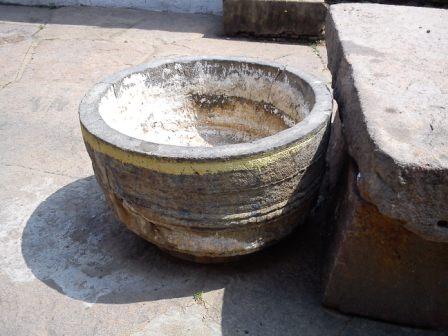
( A big stone pot )
SRI AMIRTHAVALLI
SAMETHA SRI STHAMBESWARAR SHIVA TEMPLE.
This is also one of
the rock cut Shiva temple under the control of ASI. But daily poojas are
conducted by the priests. This Seeyamangalam is about 4 KMs from Thesur, for
which we have to take left diversion from Vandavasi to Arani. There are
lot of Tamil inscriptions found on the walls of inner, outer and pillars. Here
we can see the details of warriors statues with their feelings before and after
war. The temple has the first Lord Shiva's Aanandha Thandavam is chiseled on
one of the pillar with minute details of the sculpture can be seen. Agni
in one hand and a weapon on the other. It is a wonder to see how a big Shiva Shiva Linga was taken and installed inside a small Sanctum. The sanctum Vimanam is on the top of the rock very much similar to the Valli malai
near Vellore
From the Tamil
inscriptions it is learnt that the rock cut temple was built during Pallava
kings period. As per Mr Vakula Varadharajan it is also learnt that Bodhidharma was
from this place. According to him, the film ‘Elam Arivu “ was distorted from
the original story.
LOCATION OF THE
TEMPLE : CLICK
HERE

( The moolavar vimanam can be seen on the rock )

( Majestically standing even after centuries )


( The moolavar vimanam can be seen on the rock )


( View of the temple complex )

( Tamil Inscriptions )

( Tamil Inscriptions )

( Tamil Inscriptions )

( Tamil Inscriptions )

(
We can see one Bhuta gana is playing drum under the feet of Lord Shiva, for his
dance. The snake is under Lord Shiva's feet instead of his neck. The regular
muyalakan is not under the feet of Lord Shiva )

Vamana avatar

( Front maha mandapam )
The above Photographs were taken through my Sony Ericsson X10 Mini mobile.
--- OM SHIVAYA NAMA : ---


